
Novels Aren’t Movies

October 14th, 2014 by Max Allan Collins

GONE GIRL is doing well at the box office, and many critics like it, but that doesn’t make it a good movie. It reflects a new trend – so very much at odds with Hollywood’s traditional approach – of filmmakers being extremely faithful to their bestselling-novel source, apparently out of fear of alienating the book’s enthusiastic fan base. This started with the HARRY POTTER films, and goes on through the TWILIGHT series among others. Traditionally, Hollywood has played fast and loose with even the most popular source material (GONE WITH THE WIND a famous exception), including even Peter Jackson’s Tolkien films.

Frequently I get asked about the changes Hollywood made to ROAD TO PERDITION, usually with the asker’s expectation that I’ll do a rant about what the filmmakers “did” to my book. While I don’t agree with every change made – I would have retained the adult narration and my ending – I fully understood the need to rework the material for the screen. Some of what they did was an improvement – more was done in the film with the Looney father-and-son relationship, for example, and the Jude Law character was created to be a single tracker, combining my ongoing, oncoming fleet of such hitmen into one nemesis.

Novels are not movies, and novelists rarely make good screenwriters. One of the exceptions – Donald E. Westlake – refused to adapt his own work to the screen, basically on the “fool for a client” theory. Certainly novelists have trouble killing their darlings when adapting their own work. But it has more to do with basic differences between the forms, novels being an interior telling of a story and films an exterior one. There’s a reason why many classic films come from short stories, not novels – it’s easier to expand a 40 page tale into a 100-page screenplay than to reduce and compress a 300- to 800-page novel into one. GUN CRAZY, REAR WINDOW and STAGECOACH began as short stories, for instance.

I don’t know if Gillian Flynn is a good novelist – I haven’t read GONE GIRL, but it’s certainly popular – because (as regular readers here know) I don’t often read contemporary crime fiction, for reasons I’ve stated plenty of times. Still, a couple of things seem apparent. First, GONE GIRL the novel would appear to be one of those big popular mystery thrillers read by mainstream readers who don’t regularly read in the genre. I say this because the big surprises such readers go on and on about are (in the film at least) very obvious to seasoned mystery fans.

Second, GONE GIRL – adapted to the screen by Flynn – has a structure designed for a novel. Without getting into spoiler territory, major characters are off screen for long stretches of time. There is no focus, no one to root for (or against), despite the best efforts of a strong director (David Fincher). Flynn has in interviews spoken of how many characters and scenes she dropped, and the painful process of doing so, but she didn’t drop enough – the film runs a bladder-busting three hours. VERTIGO runs a little over two hours. LAURA is 88 minutes. Both were adapted from novels, the latter from a novel with a structure similar to GONE GIRL’s, but dropped in the otherwise faithful film.

GONE GIRL is a well-directed mess, and the faults largely come from the script. I don’t know whether putting this story on film reveals flaws in the novel, or whether Flynn couldn’t figure out how to deal with character and plot weaknesses on screen. The number of plot holes are staggering (the married couple has money troubles, except that also have endless supplies of money and live in a five-million dollar home), and the characters who don’t come alive are near legion (Neil Patrick Harris, generally a good actor, is defeated by a character so unbelievable as to be laughable). Three hours just weren’t enough for Flynn. Well, for me they were.

I was reminded of Brian DePalma’s THE FURY (1978), which I revisited on blu-ray recently. Some of you will recall that PHANTOM OF THE PARADISE is one of my favorite films, and that in the mid-‘70s I considered DePalma my favorite contemporary movie director (he’s still high on my list). SISTERS, OBSESSION, CARRIE – all blew me away. THE FURY, DePalma’s first big-budget film, was a stumble, filled with great set pieces but an unfocused narrative. The screenwriter was John Farris, who wrote the original, sprawling novel. Based on what’s on screen, he provided DePalma with a bewildering Cliff Notes version of his book, retaining a novelistic structure that put star Kirk Douglas on the bench for twenty or thirty minutes at a time.
The Judge

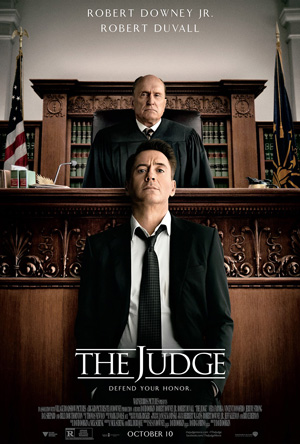
Ironically, one of the most novelistic recent films – in a good sense (rich characters, intertwining story elements, exploration of setting) – is the first-rate courtroom thriller, THE JUDGE. Chiefly the film is an acting showcase for Robert Downey Jr. and Robert Duvall, the former a big city amoral lawyer who returns to the small town he grew up in (and despises) to attend his mother’s funeral, and winds up defending his father, an idealistic judge with whom he’s been estranged for decades, on a murder charge. It’s a melodrama and a soap opera but a damn good one, and the supporting cast is rich with fine actors (Billy Bob Thornton, Vera Farminga, Vincent D’Onofrio) and interesting, fleshed-out characters. The focus is Downey. The film is leisurely at 148 minutes, but the characters and the narrative earn and use the time. The screenwriters are Nick Shenk (GRAN TORINO) and Bill Dubuque.

Of course, Rotten Tomatoes tells us that GONE GIRL is 87% fresh, and THE JUDGE only 46% fresh. Salon.com critic Andrew O’Hehir says of THE JUDGE: “It’s ‘what people want.’ Whereas I say the hell with people and what they want.” Well, guess what? I say to hell with jaded critics who have contempt for the moviegoers they are supposedly guiding. Oh, and O’Hehir loved GONE GIRL.

This is possibly another installment in my long-running AM I OUT OF TOUCH? series. But I don’t think so.

M.A.C.
How We Make The Sausage

October 7th, 2014 by Max Allan Collins

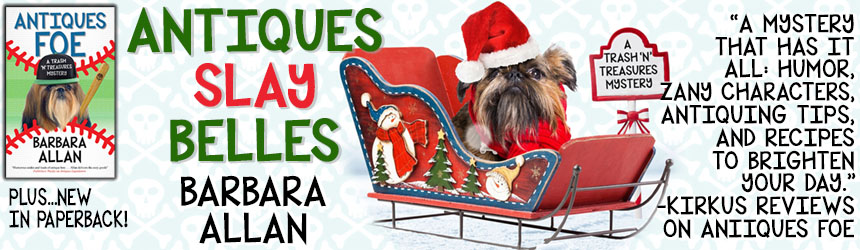
Now in Paperback!

A little more behind the scenes stuff this time….

The writing week began with detailed discussions between Barb and me over the plot of the next ANTIQUES novel, which she will be diving into soon. The story takes place outside of our usual setting of Serenity in a village that was founded by Brits and has patterned itself on their model of smalltown life.

Barb struggled some on the previous novel because we’d been a little too open-ended on our plotting, and this time she wanted to try working from a somewhat more detailed plot breakdown. Lots of back-and-forth ensued, I put my ideas down on paper, and finally she developed all of it into a several-page chapter-by-chapter breakdown. I went over this, discussed some possible changes and additions, and then we locked it. Since then Barb has written a second chapter (we had already written the first chapter, a requirement of our Kensington contract – we have to give them a brief synopsis and a first chapter for approval) and we seem to be on our way.

In the meantime, with my desk cleared of all other writing assignments, I dug in full-time on research for the next Heller novel, BETTER DEAD, which deals with the McCarthy era and specifically the Rosenberg case. Lots to read, and some of it fairly mind-numbing. I find at this age I tend to read a lot, nap a little, read, nap, etc. I was trying to get as much read as possible before the arrival of my longtime researcher (and friend) George Hagenauer. In recent years, every Heller novel has included a preliminary visit from George, who arrived Sunday afternoon around two p.m., lugging more reference books for me to read.

At this point George is more on top of the history than I am. Our sessions often involve fairly heated discussions reflecting our conflicting takes on the material. George tends to be more fixed on the historical accuracy issues (although he’s loosened up) while I am the guy reminding him that first and foremost a Heller novel is a private eye thriller. He is very good at the underlying political currents and at spotting material that can link us back (and in this case forward) to other Heller novels.

Three hours of discussion and brainstorming finally had the first (longer) section of the novel revealing its shape. The story I want to tell was fitting into, and flowing out of, the history. The timeline was behaving itself, too, so that little or no compression would be needed. But the final aspect that needed attention was (private eye thriller, remember): where will the sex and violence come from?

However much the Heller novels are historically accurate, and outpace other such novels, they still need to have the classic hardboiled PI elements – murder, lust, betrayal, action…the good stuff. So the conversation turned to: who’s trying to stop Heller in his investigation? We kicked around possibilities and came up with something fresh, largely thanks to George.

Over supper at Salvatore’s Restaurant (Barb stayed behind, as George had a cold she didn’t want to catch), we hashed out more issues. Tomorrow morning (I’m writing this on Sunday evening) we will get back to it, and talk about the final section of the book, which concerns CIA dosing its employees with LSD to see what would happen. You know, like teenagers at a party in 1968.

George will probably be on the road shortly after lunch (he came here straight from a Minnesota comic con – and ended Sunday with some comic art trading, which is how we met three-plus decades ago).

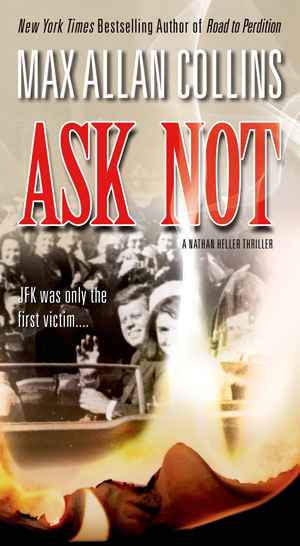
By the way, the most recent Heller, ASK NOT, has just been published in mass market paperback by Forge.

* * *

The moderator on my upcoming Bouchercon panel has taken to reading the QUARRY novels by way of prep. He’s even posted this very nice essay on the books.

And check out the Forge/Tor web site where they promote the ASK NOT paperback.

Out of Touch?

September 30th, 2014 by Max Allan Collins

It seems like periodically I have to write on the subject of how out of touch I sometimes feel with the current popular culture.

Let’s start with this week’s Saturday Night Live. I have stayed loyal to this show from the beginning, even through its weakest, most disastrous seasons. But that may be at an end. The opening episode of the new season was truly abysmal, yet I’m seeing very positive reviews online.

Let’s start with Aidy Bryant, a pleasant overweight woman who has been on for several SNL seasons for no other reason, it would seem, than to be pleasant and make overweight people feel good about themselves. She has apparently been designated a star at SNL, because she was given the central role in four sketches, during which she mangled lines on every one. The high point was a lengthy sketch were she rapped about having “a big fat ass” to guest host Chris Pratt, who was generally poorly used, particularly in a sketch that had him as a kid’s action figure come to full-size life. The joke here was that the living action figures of He-Man (Pratt) and Lion-O of Thundercats (played poorly by the talented Taran Killam) patted their genitals and ate cake or anyway smeared their faces with it. This travesty, which appeared in the post-monologue sweet spot, was among the worst SNL sketches I’ve ever seen.

Weekend Update has replaced Cecily Strong with Michael Che, who did an okay job, with Strong back to do a trademark dumb girl character abandoned last year when she became an effective co-host with the bland Colin Jost. A new player, Pete Davidson, 20, did a piece about how it would be okay to have fellatio for money. This was (I kid you not, as Jack Parr used to say) the best thing on the show. (Next best was a Marvel movie trailer parody, not a live piece.) A pair of weak sketches on the NFL scandals (including the “cold open”) failed to score any points. Another sketch was based on the hilarious premise that every animal taken to a pet hospital promptly died. Online, Slate (among others) raved about the episode.

Let’s not leave out the musical guest. A small, attractive young woman – Ariana Grande – wore cat ears for both her songs (neither of which were about cats) and sang in a breathy, almost-on-pitch articulation-free caterwauling (maybe that’s the connection) imitation of Lady Gaga, which is like a soft drink imitating Pepsi, in this case badly. In cat girl’s second number, a black guy with a bizarre haircut that looked like a vulture was perched on his skull came out and did some sing-songy stuff. Turns out his name is the Weeknd. That’s right, no damn third “e” for Weeknd!

Here’s my “Weeknd” Update: SNL, I give up. How can anybody older than twenty-three identify with this stuff, and why the hell do they like it?

Moving on to films, the critical favorite THE BOX TROLLS (yes, Barb and I went to it, further establishing my son’s theory that I will go to any 3-D movie) turned out to be the most hideously unpleasant “family movie” I’ve ever seen. Highlights include: a boy at a fancy party noticing he should be using a fork, prompting him to puke up his food on his plate and eat it with a fork; a villain who loves to eat cheese (the “money” of this quaint Brit village) even though he’s allergic, causing his lips and other parts of his face to swell up grotesquely (SPOILER ALERT: he eventually explodes, Mr. Creosote style); and a long-lost father who has been tied upside down in a dungeon for a decade, causing him to grow a lot of facial hair and giggle as he yells, “Jelly!” Everything in the film – technically well-made, involving many talented artisans – is ugly and frequently horrific.

I don’t mind kids getting scared in movies. In fact, I think it’s good for them. Give them a taste or two of the Island of Lost boys and a poisoned apple. But not a steady diet. BOX TROLLS is whimsical without wit, precious without point, nary a laugh in the over-long dire mess. And guess what? It’s rated 72% fresh on ROTTEN TOMATOES!

The Equalizer

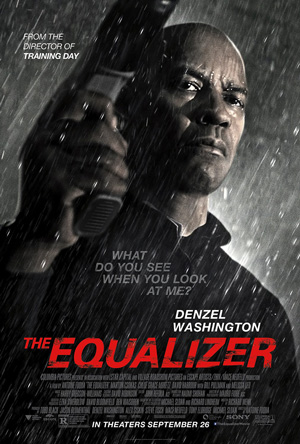
On the other hand, the terrific Spillane-style THE EQUALIZER with Denzel Washington opened to some devastatingly bad reviews (Entertainment Weekly gave it a D-), though it did well at the box office and has since risen to 60% fresh on Rotten Tomatoes. This gives me hope. By the way, I invoke Spillane because THE EQUALIZER and the TV series it’s based on were pure Mike Hammer. The film even begins with a scene that re-works the opening of MY GUN IS QUICK. Washington is terrific as the self-contained, haunted hero, and a final action sequence in a Menard’s-type big-box store is blackly funny and satisfying as hell.

But it seems like out here in the hinterlands that I have to work very hard to find even an okay movie to go to (I like to go once a week). These days TV is more my go-to place for quality storytelling. MASTERS OF SEX just wrapped up an amazing second season, for example. Last week Barb and I enjoyed season eight of MURDOCH MYSTERIES, as I mentioned, and I understand more LEWIS is coming. JUSTIFIED’s final season is on the way, and more ARCHER lies ahead. AMERICAN HORROR STORY, too.

So I am relating to certain things in current popular culture.

But cat ears? Is a thing?

* * *

Here’s a pretty good review of SUPREME JUSTICE. About as good as I can expect from somebody who spells my middle name “Allen.”

Here’s a good list of hardboiled/noir books and writers (linked here because I’m on it!).

Check out these delightful reviews of SEDUCTION OF THE INNOCENT and STRIP FOR MURDER (scroll down for A KILLING IN COMICS, previously linked here). What Rip Jagger does is intersperse photos of the real-life folks I used as the basis for characters – very cool.

My role in getting GET CARTER and other Ted Lewis books back into print is mentioned here, but the overall piece is terrific…like Ted Lewis.

Finally here’s a very good interview with my pal Ed Gorman, one of our best writers, from Gravetapping.

M.A.C.

Barbara Allan: How it Works

September 23rd, 2014 by Max Allan Collins
Antiques Fruitcake

No question comes my way more frequently than, “How do you and your wife Barb collaborate on the ANTIQUES books?” Well, actually, I’m more often asked, “Has anybody told you that you look like Elton John?” But not much.

As I spent last week working on a Barbara Allan project, this seems as good a time as any to answer the first question. (As for the second question, there’s no answering it that will make it go away.)

As part of our most recent contract with Kensington Publishing, Barb and I agreed to write three novellas in the ANTIQUES series in addition to three full-length novels. The idea was to write novellas that could be e-books in an effort to attract new readers, and to prime readers for the next book in the series.

Further, each novella was to be Christmas-themed. This set the stage for possibly collecting the novellas, maybe with a new one, in book form at some point. Looking at the writing of one of these novellas should provide a study in microcosm of the collaborative writing process used by Barb and me on the novels themselves.

The work began several months ago with a series of conversations, fairly casual, about what the basic story would be, and what the title might be. Titles are tricky on these Christmas novellas. Coming up with something clever, like HO HO HOMICIDE or CHRISTMAS STALKING isn’t that tricky (although lots of possibilities have been used, including those); but in our case we have to include ANTIQUES in the title. Something like ANTIQUES CHRISTMAS STALKING has about as much music as a trombone falling down the stairs.

The first of the novellas was ANTIQUES SLAY RIDE and the second (which will be e-published a week from today) is ANTIQUES FRUITCAKE. We considered ANTIQUES MISTLETOE TAG, but that damn “Antiques” made it clumsy. So – we gave up and moved on to figuring out the story.

As is our habit, we kicked around ideas over lunch at various restaurants. Barb suggested something to do with a street-corner Santa Claus getting killed for his donation bag. But that had no “antiques” aspect, so I suggested somebody had put a valuable old coin in the bag, possibly by mistake. Then came the notion that our Santa was not Salvation Army variety, but a good-hearted local person raising money for some good cause. And the valuable-coin donation was on purpose.

From there came both a more detailed plot – with the same kind of back-and-forth brainstorming that Matt Clemens and I engage in – and a possible title. ANTIQUES SECRET SANTA. Finally I came up with ANTIQUES ST. NICKED, which became the title (unless Kensington hates it).

About five weeks ago, we finalized the chapter breakdown (over lunch, of course). When the Hollywood pitch trip came along, Barb went with me and worked on the ANTIQUES story in our hotel room while I was off on meetings. She got her draft of the first of five chapters written.

Back home, she continued at a rate of one chapter a week. In the meantime, I was doing two drafts of that TV script I’ve mentioned as well as several smaller writing jobs I agreed to do in weak moments. A week ago, she turned over her five-chapter, 69-page draft to me.

Monday through/including Thursday, last week, I did a chapter a day, revising, expanding, tightening, tweaking. Along the way I would have plot and character questions for Barb, which she would answer, or that she and I would discuss and work out. End of day she’d read my draft, mark it up, and I would enter her changes and corrections, either then or the first thing next work day.

Friday was beautiful, so we said, “Screw it,” and had one of our typical getaway days, going to the Amana Colonies and then Cedar Rapids for food and shopping. Saturday I did the final of five chapters, and on Sunday we both read the manuscript, first Barb, then me, each making notes and corrections.

Reading any long manuscript that you’ve written a chapter at a time, without doing much referring back as you go, means you’re likely to encounter plot and continuity problems, and that happened here. One thing that happened was that several things in our plot and on a “CHARACTERS/SUSPECT” sheet that Barb had prepared for me had not made it into the manuscript. We wrote them in. By late afternoon Sunday, the manuscript was finished – now 84 pages.

We may not turn it in for a while – that will be our editor’s call – because we did this story way early, in part because Barb needs to get cracking on the next ANTIQUES novel, but mostly because the deadline for the second Caleb York novel (also for Kensington) is the same day as for this novella. A “yikes” would not be inappropriate here.

It’s hard for a writer to know, right after finishing something, if it’s worth a damn. Barb is still just shrugging, shaking her head and making faces about this one. I feel more confident that we have just the right mix of our typical format with our characters presented well, a tricky little mystery, Christmas theme, serious subject matter handled delicately, and lots of laughs.

* * *

Here’s a very good, flattering essay about my work that morphs into a Chicago crime piece. I do wonder if the writer knows that much of what he goes on to discuss was dealt with in my novels ROAD TO PURGATORY and ROAD TO PARADISE.

Here’s a great little piece (with mentions of yours truly) on one of my favorite paperback writers of the ‘60s, Ennis Willie. (I’ll be talking about him and several other under-appreciated writers on a Bouchercon panel.)

Finally, check out this generous write-up, having to do with my writing a brief advance review of a book on Milton Caniff and his STEVE CANYON character Miss Mizzou.

M.A.C.