
I caution the easily offended – and even those who are understandably offended – but what I have to say in today’s update will frequently contain a certain word that likely originated from Germanic or Old Norse languages (e.g., ficken, fokken), meaning “to strike,” “thrust,” or “move back and forth.” It has for centuries been a forbidden, rude word. And it’s going to appear throughout this little essay.
So buckle up, or fuck off.
I remember the first time I heard the word. It was during recess on the schoolyard – specifically Grant School here in Muscatine, Iowa, in the mid-1950s. It came from a particularly scruffy kid and I knew, from the glee with which it was spoken, that I had heard something special, and not in a good way. I inquired of a fellow classmate and was told, in no uncertain terms, that this word was one that could get a kid (scruffy or not) in a world of trouble.
By junior high (this was now the late fifties/early sixties), the word sneaked out from the locker-room lips of my fellow classmates. The first time I saw it in print was in the novelization of the original Ocean’s Eleven (1960). It startled me enough that I remember the specific instance and where I was at the time (study hall).
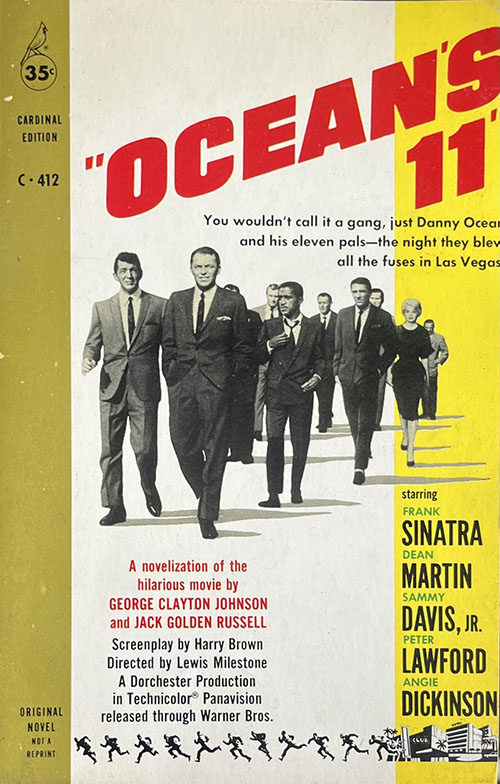
And I didn’t see it again in print for perhaps a year – possibly in a Harold Robbins novel. But I read a lot of sleaze in those days (and nights) and can assure you its appearances on the page was infrequent.
By high school, however, the word ran rampant. My group of guys had nicknames for each other that we found absolutely hilarious – of course one of us was Fuck-head, another Fuck-nose, yes Fuck-butt and the supremely offensive Fuck-shit, which had us in stitches. Hard to believe as it may be, I do not remember which “Fuck” designate I bore.
By high school graduation in 1966, “fuck” was damn near casual among my male crowd, and by community college and my U of Iowa days it was beyond common among all sexes. Athletes and hippies alike were sporting and snorting language that had begun creepy-crawling into the American vocabulary after soldiers came back from fighting WW2 overseas.
As a budding writer – I began writing short stories and novellas in junior high, and novels in high school – I was struck by how rare the word “fuck” appeared in print, even as it had wormed its way into more casual conversational use. But even in those days, “fuck” had weight. It made a point.
I took great pride in being one of the first writers to use “fuck” and “fucking” and “fucked” rather freely in my fiction. I may have been the first to use the phrase “Jesus fucking Christ” (you’re welcome). I was breaking down, or anyway helping break down, a fairly stupid barrier. I felt that people in my novels needed to sound something approximating how people actually talked. “Fuck” coming out of the closet lost some of the word’s power, but that struck me as all right.
And yet.
“Fuck” has become something lazy writers use far too often, particularly in films. Recently Barb and I went to Ready or Not 2: Here I Come, a sequel to (not surprisingly) Ready or Not. We liked the first movie and had a great time with the second one, too. We were fine with the violence and the mean-spirited fun – we knew what we were getting into, after all. Not everyone likes those movies, but we find them enjoyable dark comedies.
And…yet….
The dialogue, as is so often the case now, was just one “fuck” (and its derivatives) after another. It’s a tempting word to use. It has a history of power, even if it’s lacking in power now. It’s so much more satisfying than “damn” or even “goddamn,” since you land on a soft “m,” and who is impressed by “god” anymore, anyway?
And “fuck” has that wonderful “fuh” at the start and hard landing on the “k.” But that hard landing is dulled by overuse. The opening episode of For All Mankind’s fifth season – a solid, smart show – presents an alternate history of the space program in which everyone seems to live on the planet “fuck.”
I’m not talking about the act of, you know, fucking. Just the word. I still like to use it for that special punch. That unexpected kick. Only it increasingly packs a lesser punch, and it’s become more and more the refuge of writers who think the more salt you shake onto the meal, well, the tastier it’s gonna be.
In writing Return of the Maltese Falcon, I had great fun doing variations on Hammett’s way around using the then-forbidden word “fuck,” when gunsel Wilmer Cook insults Sam Spade – “The boy spoke two words, the first a short guttural verb, the second ‘you.'”
So to all you aspiring writers, whether of novels or screenplays or comics, my advice is: use some goshdarn restraint. Sprinkle the salt on your prose, don’t pour the fucking shit – it’s not a Winter sidewalk.
Anyway, it’s Spring now, so back the fuck off.
Some folks have asked about the major missing list from my recent couple of rounds of lists, so here it is:
FIVE FAVORITE MYSTERY WRITERS
1. Mickey Spillane
2. Dashiell Hammett
3. Raymond Chandler
4. Rex Stout
5. Agatha Christie
(number six is Erle Stanley Gardner)
One of the reasons why I say “favorite” and not “best” is that these are personal distinctions, not absolute opinions.
Let’s rearrange the list.
BEST MYSTERY WRITERS
1. Dashiell Hammett (from which everything noir flowed)
2. Raymond Chandler (the biggest influence on the genre)
3. Mickey Spillane (the writer who transformed the genre)
4. Agatha Christie (the greatest plotter)
5. Rex Stout (the most entertaining)
So while Stout comes in #4 on my favorite list, and #5 on my best list, I have no trouble admitting that I’d rather sit down to read a newly discovered Nero Wolfe/Archie Goodwin mystery than something by anyone else on these two glorious lists.
No further explanations will be offered (probably).
I am pleased to see that Road to Perdition (the film) continues to attract attention, particularly as a notable movie based on a “comic book.” These are worth checking out.
https://intheseats.ca/the-its-lists-comicon-special-top-non-superhero-comic-book-movies/
https://fanboyfactor.com/2026/03/movies-you-didnt-know-came-from-comics/
My buddy Heath Holland’s Cereal at Midnight YouTube videos are always worth a look. Heath and I have been doing frequent commentaries for Blu-ray releases for the likes of Kino Lorber and Imprint. We’ll be doing one this afternoon.
Heath recently interviewed me about my return to indie filmmaking, by way of micro budgets. This covers ground no one else has. You may find this worthwhile.
The True Noir event at the Putnam Museum and Science Center in Davenport, Iowa, has been rescheduled for May 28 and 29 (the last Thursday and Friday of May). On the first night we’ll be screening the restoration of the 1941 Maltese Falcon on the Putnam’s IMAX screen, followed by Robert Meyer Burnett (flying in from California – I believe he’s lining up at the airport now) interviewing me about Return of the Maltese Falcon. On Friday we’ll be presenting in the IMAX theater the opening chapters of our full-cast audio drama (based on my novel True Detective), True Noir: The Assassination of Anton Cermak.
Much more about this as the event approaches.
M.A.C.
Tags: Appearances, Nate Heller, Return of the Maltese Falcon, Road to Perdition, True Noir, True Noir: The Assassination of Anton Cermak, True Noir: The Nathan Heller Casebooks