Posts Tagged ‘Spillane’

Cry U.N.C.L.E.

Tuesday, August 18th, 2015
The Man From U.N.C.L.E. 2015

I was a junior and then senior in high school in 1964, when Beatlemania hit, and I was as caught up in it as anybody. The recent anniversary of their Shea Stadium concert got a lot of nostalgic talk going, particularly on oldies radio. (Not that someone as hip and culturally relevant as me listens to such a thing.) What hardly anybody discusses, though, is where the concurrent spy craze fit in.

Of course, James Bond – his anti-Beatles remark in the otherwise great GOLDFINGER a rare tin-ear moment from the filmmakers – was a big part of the British invasion. The success of the first few Bond films meant imitations were inevitable, and lots of spy stuff hit the screens, some of it more straight like THE SPY WHO CAME IN FROM THE COLD and THE IPCRESS FILE, but a lot of it crapola like the Dean Martin “Matt Helm” abominations.

A ton of the imitations came out of Europe, particularly Italy, and those mostly terrible movies – for which I have an inexplicable fondness – are now lumped together as the Euro-Spy genre. The two OSS 117 parodies of recent years were takes on Bond, yes, but also on the straight OSS 117 movies from the ‘60s based on a long-running novel series that actually pre-dated James Bond. Some of these are among the best Bond imitations – SHADOW OF EVIL, MISSION FOR A KILLER, PANIC IN BANGKOK. (These are either unavailable in the USA or available only gray-market and/or pan-and-scan form. Check out Amazon France for better copies, most of which have English subtitles.)

But in Iowa in 1964, only the really mainstream spy movies made it here (again, the Dean Martin junk, and the very good Harry Palmers with Michael Caine) and that was true for a lot of the country. Buffs for this stuff wouldn’t see the Euro-spy movies until they hit TV a decade or two later in butchered, horrendously dubbed format, or in the last few years as DVDs and Blu-rays, often with wide-screen images intact and English subtitles. I particularly like the Joe Walker/KOMMISAR X series from Italy, but there’s no excuse for it.

Meanwhile, back in ‘64, television stepped in to feed a spy craze that couldn’t breathe on one Bond film a year and occasional double-feature double-oh-seven re-releases. So a number of spy series hit the small screen, most prominently THE MAN FROM U.N.C.L.E. (co-created by Ian Fleming, a fairly little known fact) and I SPY. I’ve revisited both series in the last several years, and neither holds up very well. Of course, I SPY is now on the pop-cultural scrap heap, thanks to Bill Cosby’s little hobby.

THE MAN FROM U.N.C.L.E. was always spotty. A few years ago, working my way through the show in a spy’s briefcase, I knew I was in trouble when late in the first season – generally considered to be the best – an episode written by the great Robert Towne blew chunks. But at the time, the show was a very big deal. The first episode was expanded, shown in color (the pilot had been shot that way but the first season was otherwise in black-and-white, and the pilot aired that way), and some new violent, sexy scenes were inserted. Also a big scene with David McCullum, who was a non-entity in the pilot but had Spock-like popularity with viewers that got him the second lead, very quickly. This cunning patchwork was titled TO TRAP A SPY and was released theatrically to some success. There were seven more of these recycled MAN FROM U.N.C.L.E. movies, mostly utilizing TV two-parters, although only the first two did well, and several went overseas with no stateside theatrical release. They are available as a set on DVD from Warner Archive.

Though Bond was obviously immune, the spy craze died quickly, particularly on TV. THE MAN FROM U.N.C.L.E., in its third season, went campy, following the lead of the new craze, the Adam West/Burt Ward BATMAN. Everybody hated this version of U.N.C.L.E., and the next half-season (they were cancelled midway) went back to more straight fare, too late. I SPY lasted three seasons. MISSION: IMPOSSIBLE, thanks to great music and a cool premise, out-lived every other espionage show of the era.

What most Baby Boomers remember about THE MAN FROM U.N.C.L.E. (and U.N.C.L.E. was not Uncle Sam, but an organization that seemed vaguely tied to the U.N. for worldwide law-enforcement) (no, I won’t spell out the acronym) are Robert Vaughn as Napoleon Solo (a name Fleming contributed) and David McCallum as Illya Kuryakin. The latter with his Beatle-esque haircut and understated Russian accent was a big pop-cultural deal. Vaughn, smooth and unruffled and impeccably attired, was arguably the best secret agent of the craze but for Bond himself.

So you’re waiting for me to slam the new movie, I suppose. Well, I’m not going to because it’s terrific. Director-co-writer Guy Ritchie has made a sly, darkly funny film that invokes not just the series but Bond and the entire spy craze era, with the look of the film drawing heavily upon the Harry Palmer trio. The twisty script is sexy and clever and occasionally scary. The music is witty and mixes zither exoticism out of FUNERAL IN BERLIN with Ennio Morricone cues, during which the direction takes an overtly Serio Leone take. The leads are fine, Armie Hammer redeeming his LONE RANGER travesty with a Kuryakin reworked into a volatile near psychotic, while Henry Clavill channels Robert Vaughn. It was this near impression – revealing the actor had really studied the series – that won me over early on. Clavill has Vaughn’s cadence and cool, as well as the dimple in his chin.

It’s an origin story, and U.N.C.L.E. itself is barely introduced at the end, though charmingly so, Hugh Grant nailing the spy agency’s boss, Alexander Waverly (the great Leo G. Carroll on the TV series). It sets up a series of films that probably won’t happen. Unfortunately.

Something this smart and witty may not work on the current generation, who won’t get the references and will wonder why every scene isn’t an action one, like the latest video game or the new MISSION: IMPOSSIBLE. Now I liked the Tom Cruise film, found it great fun, but it’s just one Cruise action set piece after another linked by clumsy expository scenes and winning comedy relief from Simon Pegg. THE MAN FROM U.N.C.L.E. won’t be everybody’s cup of spy, but it’s my favorite film of the summer.

* * *

Here’s a knock-out of a review of KING OF THE WEEDS from the Crime Review site.

And my 1981 Nolan novel, HUSH MONEY, made number two on the best reads of the month at Col’s Criminal Library.

M.A.C.
The Name’s Sam Plus Hammer Suits Up

Tuesday, August 11th, 2015

I mentioned this in a reply to a comment last week, but for those of you who missed it: our grandson has a name – Samuel Allan Collins. Sam. Some of you may recall that Sam is Nate Heller’s son’s name, and of course there’s Samuel Dashiell Hammett and a man called Spade. So I like the resonance, although I didn’t come up with the moniker.

He’s a little guy – he was early – and he’s dealing with a few problems, but he’s a scrapper, and his parents are with him all the way.

* * *
Don't Look Behind You

I am prepping for the next Mike Hammer, which I intend to start very soon (by the time you read this, it’ll be under way). You might be curious as to my process.

Of course it varies every time, because I am generally dealing with manuscripts from Mickey in various states and shape. This time I have about thirty pages of his to start with, but I also have plot and character notes, and the roughed-out ending.

One problem I deal with every time is dating the manuscript. My policy has been to maintain continuity with the existing Hammer books as they were written and published. The idea is to capture Mickey and Mike in the right creative context, as opposed to me just writing my idea of a general Mike Hammer book. Sometimes it’s a snap, as with LADY, GO DIE!, which was clearly designed to be the second novel.

This time I had to search out clues in the manuscript. It feels like an early work, a ‘50s piece, but evidence in the narrative finally led me to realize it was written around 1967. The evidence, specifically, is that Hammer mentions three major New York newspapers that have recently died. Researching them, I found all three folded in 1966.

Next step is to read some Mickey and get in the mood and the swing. What I like to do is read material that was written around the same time as the manuscript I’m completing. In this case (as someone once said), “It was easy.” Mickey published THE BODY LOVERS in 1967. So I am currently reading that novel, which I have grown to like and respect more and more as I’ve read and re-read it over the years. I mark the copy up with a highlighter, as if it were a text book for school.

In addition, Barb and I listened to the fine Stacy Keach abridgment of KISS ME, DEADLY on a recent day trip to Galena, Illinois. That book obviously wasn’t written in the ‘60s, but it always help to get some genuine Spillane vitamins into my system. An upcoming trip to St. Louis, to visit the grandson and his parents, will have me going all the way to the start, listening to the new Mike Dennis-read unabridged I, THE JURY.

These thirty pages will be expanded into around sixty, at least. The plot outline (there are several, somewhat contradictory) will need some serious thought. But I am itching to start and will probably deal with Mickey’s existing material before I plot the rest of the novel (from his notes).

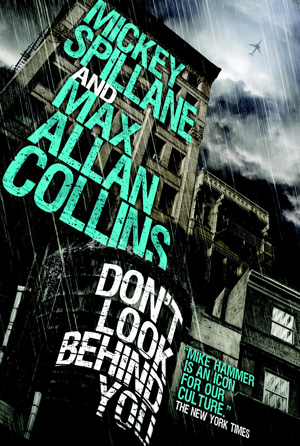
The book will be called DON’T LOOK BEHIND YOU (a Mickey shout out to his favorite mystery writer, Fredric Brown) and the cover already exists, shared with you here.

* * *

Rich Whitney Turner has written a lovely tribute to, uh, well…me. Do please check this out.

M.A.C.

A Fair Hearing

Tuesday, August 4th, 2015

Barb and I visited our son Nate, his bride Abby and our new grandson (still unnamed at this writing) over the weekend in St. Louis. The little guy – he was early, and truly is little – is doing fine, and so are his parents. It was a fun visit and heartwarming, and I’ll stop right there before everybody gets sick.

I mentioned last time that there’s a new audio out of my 2008 X-FILES movie novelization, I WANT TO BELIEVE. We listened to it on the ride down and back, and enjoyed it – the narrator, Patrick Lawlor, did a good job. I rarely revisit a movie novelization, and this proved interesting for a number of reasons.

First, as often happens when I listen to an audio of my work, I am in a best-of-times-worst-of-times mode. I usually have forgotten enough about the plot (whether my own or some screenwriter’s) to enjoy the novel as a narrative. But I also cringe at things that I will never get the chance to fix. In writing a novelization of a film, the work often goes fast and has to be handed in on a near-impossible deadline, and I WANT TO BELIEVE could definitely have benefitted from another pass where I tweaked and fixed things. On the whole, though, it came out pretty good. Or as Larry David would say, “Pretty, pretty good.”

When we got home, I decided to look at the film itself. I had it on blu-ray but hadn’t watched it since I saw it in the theater. I haven’t done a movie novelization in a long time (I WANT TO BELIEVE was one of the last), but my most vivid memory of those days is that seeing the film in a theater was always a weird experience for me. I had spent enough time writing the novel that the narrative on hand seemed my own (a delusion). A fact of life for the writer of a movie novel is that you work from a screenplay and do not get access to the film itself, though you are expected to mirror that film. Now and then, you get a few clips and the X-FILES people were generous with wardrobe sheets and cast lists, and were always there to answer questions (“What kind of car does Scully drive?” “What color?”). But mostly you’re flying blind, as screenplays are notoriously bare bones.

Seeing the movie after having just heard the novelization made me feel good about what I’d accomplished. I had definitely imagined, and recorded, a movie from that screenplay that tallied well the actual film. The biggest difference was an odd one. The main villain was described in the screenplay as having black stringy hair and craggy ugly features, and was frequently linked to the Russian madman, Rasputin. In the film itself, blond, rather handsome actor Callum Keith Rennie – who was a good guy co-star on one of my favorite TV series, DUE SOUTH – was the bad guy. So that change was startling.

Others were very minor. A couch turned into a folded-out day bed; bone marrow cancer became lung cancer. Otherwise, I pretty much conjured up the same movie, albeit on paper. Some of the character names – no doubt forced by the legal department on the filmmakers – I disliked. One tough African-American FBI agent was called “Wesley Drummy.” Horrible name, not at all suited to the character. In the film it gets used once or twice; in the book I had to use it all the time. A number of awkward character names made the book seem klutzy at times – this is not at all uncommon in the novelization game. You’re stuck with these stupid names.

I liked the film, which remains much maligned. I do think the X-FILES folks made a major mistake in having Scully and Mulder at odds and separated through much of the story. Nothing wrong with that story, but a crucial creative meeting was skipped – the one where everybody sat down and asked each other, “What do X-FILES fans want to see?” Not Dana Scully turning her back on the FBI and Mulder to tend to a little kid with a brain tumor.

The experience of hearing my books on audio is always gratifying and frustrating. I careen between thinking, “That was a really nice scene/line/description,” to, “Jesus, I wish I could fix that!” And you are the captive of the audio-book reader. I’ve had some great ones, quite a few good ones, and some terrible ones. One guy read DAMNED IN PARADISE in a bad Bogart impression. (I gave my freebie copies to friends as gag gifts.) On the other hand, the Hellers have all been read in recent years by the excellent Dan John Miller, who has virtually become Nate’s voice.

The day I’m writing this, Dan is in the studio reading FATE OF THE UNION. He did a fantastic job on the first book in the Reeder and Rogers series, SUPREME JUSTICE, and both Matt Clemens and I are thrilled to have him back for FATE. Dan also did a great job on THE WRONG QUARRY, but the new Quarry audio book publisher, Skyboat, features the QUARRY novels as read by the excellent Stefan Rudnicki. Rudnicki is an older, huskier Quarry, a deeper voice than the character usually receives but an excellent, expressive reader. He knocked the ball out of the park on QUARRY’S CHOICE.

* * *

My friend Mike Dennis campaigned long and hard to get to record an audio of I, THE JURY. Check out his story here.

And, finally, here’s a good if somewhat patronizing review of ANTIQUES SWAP.

M.A.C.

Mike Hammer Shoots .500

Tuesday, July 14th, 2015
Death Sentences

Actually, Mike Hammer probably has shot five-hundred in his career, but I refer not to bad guys but the fact that at the International Association of Media and Tie-in Writers “Scribe” Awards, KING OF THE WEEDS did not win Best Novel, while the Hammer short story, “It’s in the Book,” did win Best Short Story.

No complaints. The Scribes have been great to the Spillane/Collins collaboration – we’ve won once for Best Novel (KISS HER GOODBYE, twice for Best Short Story (“Book” and “So Long Chief”) and once for Best Audio (“Encore for Murder”).

I am particularly pleased to see “It’s in the Book” honored, because it’s my favorite of the Hammer short stories (and it was overlooked by the Edgars and Shamuses, which had both singled out “So Long, Chief”). Right now I have one more Hammer fragment that would work as a short story, and I may save it for an eventual collection.

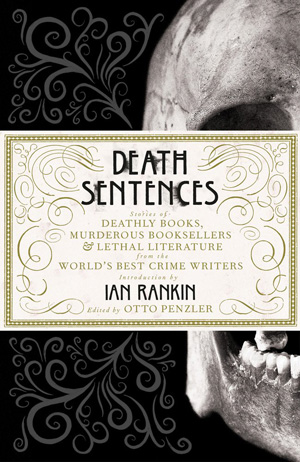
“It’s in the Book” is available as a small book and has been collected in a book club collection (see Mike Doran’s comment last time) and in the UK in a collection called DEATH SENTENCES.

Here are all the Scribe nominees with winners in bold face:
BEST ORIGINAL NOVEL – GENERAL
24: Deadline by James Swallow
Murder She Wrote: Death of a Blue Blood by Don Bain
Mike Hammer: King of the Weeds by Mickey Spillane and Max Allan Collins
Homeland: Saul’s Game by Andrew Kaplan
The Killing: Uncommon Denominator by Karen Dionne

BEST ORIGINAL NOVEL – SPECULATIVE
Sleepy Hollow: Children of the Revolution by Keith R. A.
DeCandido
Grimm: Chopping Block by John Passarella
Star Trek: Disavowed by David Mack
Star Trek: Foul Deeds Will Rise by Greg Cox
Grimm: The Killing Time by Tim Waggoner
Pathfinder: The Redemption Engine by James Sutter
Fringe: Sins of the Father by Christa Faust

ADAPTED NOVEL – GENERAL AND SPECULATIVE
Dawn of the Planet of the Apes by Alex Irvine
Noah by Mark Morris
War of the Worlds: Goliath by Adam Whitlach

YOUNG ADULT – ALL GENRES, ORIGINAL AND ADAPTED
Spirit Animals: Blood Ties by Garth Nix and Sean Williams
Battletech: The Nellus Academy Incident by Jennifer Brozak
Penguins of Madagascar by Tracey West

SHORT STORIES
Pathfinder: Hunter’s Folly by Josh Vogt
Mike Hammer: It’s in the Book by Max Collins and Mickey Spillane
Stargate: Perceptions by Diana Botsford
Pathfinder: Queen Sacrifice by Steven Savile
Tales of Valdemar: Written in the Wind by Jennifer Brozek

AUDIO
Dark Shadows: The Darkest Shadow by Nev Fountain
Dark Shadows: The Devil Cat by Mark Thomas Passmore
Blake’s 7: Fortuitis by George Mann
Doctor Who: Iterations of I by John Dorney
Pathfinder Legends: The Skinsaw Murders by Cavan Scott
GRANDMASTER (“the Faust Award”): TERRANCE DICKS

* * *

I note with sadness the passing of writer Tom Piccirilli, a very gifted man who reviewed many of my novels, and always favorably. When a writer as fine as Tom likes your work, you figure you’re doing something right.

Many tributes have appeared, but I’ll provide just this link to my friend Jeff Pierce’s write-up at the Rap Sheet.

* * *

Here’s a lovely review of THE LEGEND OF CALEB YORK from James Reasoner, who – like my pal Bill Crider – is a real western writer. When I pass muster with guys like James and Bill, I breathe a sigh of relief.

M.A.C.