


Road Trip

February 7th, 2017 by Max Allan Collins

Paperback:
E-Book: Amazon Google Play Kobo iTunes

One of the nicest things that happened to me last year – acknowledging that 2016 was something of a mine field I barely navigated – was the first-time publication by Brash Books of my complete prose version of Road to Perdition.

Thus far, however, we don’t seem to have sold many copies, and at risk of a hard sell, I want to encourage readers of mine in general and of Road to Perdition in particular that this is a book you don’t want to miss.

Perhaps you’ve read the graphic novel and don’t see the point in revisiting this story, particularly if you’ve seen the movie. Or maybe you read the previously published version and figure that, even though it’s 30,000 words shorter, you’ve already experienced this story in prose.

You haven’t. The Brash publication of Road to Perdition brings into print (and e-book) one of my best novels. And it’s a novel that begins (and in this case completes) the trilogy of Road novels that includes both Road to Purgatory and Road to Paradise.

I should also make clear that the new Road to Perdition novel (and it’s “new” despite having been written in 2001) is not just 30,000 words longer – it’s a different novel entirely. To explain, I have to revisit the painful experience of writing it.

Knowing that someone would write the “novelization” of the film based on the graphic novel by Richard Piers Rayner and me – and being, at the time, a hot property among novelization writers – I lobbied to get the assignment myself. I had already done the very successful novelization for DreamWorks and NAL of Saving Private Ryan. It sold half a million copies and was on the New York Times bestseller list. I got the Perdition assignment.

My approach to writing a movie novelization (I hate that term!) is not entirely standard. Unlike a lot of tie-in writers, I throw out much of the dialogue and write my own. (I’ll speak in the present tense here, though it’s doubtful I’ll ever write another movie tie-in novel.) My reasoning is that movie dialogue and novel dialogue are two different animals. In addition, movie scenes – very short, often two pages or less – need fleshing out.

Similarly, movies tend to skip scenes and let the viewer fill in. A movie doesn’t have to explain how a bunch of characters got from point A to point D, because the movie depicts those characters at point D – so they must have got there, right? But in the novel version, I would write about getting from point A to point B and point C before doing point D. In other words, I add scenes.

I once had a call from director Jonathan Moslow, whose U-571 I had novelized. He told me how much he liked the book – this was the only such call I ever received, by the way – but wondered how I’d known to cut several scenes and also to add several others that had not been in the screenplay. I explained that, in my modest way, I was a filmmaker myself – that I’d directed a handful of indie features. And when I read certain scenes, I’d known they’d be skipped; and when I added certain scenes, I’d known they’d be needed…or at least would flesh out the narrative for a reader of the novel.

In Saving Private Ryan, I not only changed the dialogue and added scenes, I did considerable research and wove all kinds of factual material into the narrative. (Later, when I was signed to write the Windtalkers novel – about the Navajo code talkers – I was specifically asked to give that script the same Saving Private Ryan-style research-driven approach.)

What I had learned, doing a dozen or more novelizations, was that what the Hollywood folks wanted me to do was “follow the script out the door.” In other words, I needed to include every beat of action and narrative in the screenplay, preferably in the same order. A conversation about something could be in different words than the screenplay, as long as it appeared in the same place and covered the same ground.

So when I approached the novel version of Road to Perdition, I took my usual approach. I wrote my own dialogue, and I restored material from the graphic novel that had not been in the screenplay. I provided linking scenes. I also added a lot of period detail and historical material that hadn’t made it into the graphic novel, either. The memoir aspect of the graphic novel I restored by way of italicized first-person openings for each chapter.

The novel was substantial for a movie novelization – something like 80,000 words – and I was proud of it. Felt it was my best movie novel and that it was a real complement to the original graphic novel. I sent it to my agent, who liked it very much (and he’s a tough audience), and the tie-in editor at NAL said it was the best movie novelization he’d ever read. He was thrilled. Ecstatic.

Happy times at the Collins household.

Then the DreamWorks people got hold of the book. They were not pleased. They could not have cared less that I was the creator of the original material. What they wanted – what they demanded – was that all of the dialogue from the screenplay be included, exactly as written. They also wanted any material not in the screenplay removed.

I made my case through my agent, and later directly to the editor. But editors who have a movie novelization on their lists answer to the movie studio, who must sign off on the manuscript before publication. So those editors tend not to rock the boat. Whatever the studio wants, the studio gets.

I went through numerous rewrites. In the first of these I put the movie dialogue in, but retained the extended dialogue of my own that had lengthened the scenes fore and aft. This is a necessary novelization technique because movie scripts tend to run 100 to 120 pages, and by contract the novel usually must reach 300 pages. Simple math means that some material needs to be added.

Nonetheless, I was required to remove any dialogue that had not been in the screenplay. To get the book up to any sort of length at all, I changed patches of my dialogue into third-person interior monologue. That’s one of the reasons why the complete Perdition novel isn’t just longer than the previous version, but substantially different.

The craziness continued. As the movie went through various stages of post-production, I was required to cut any scenes that were cut as the film itself was tightened in editing. Most novelizations include scenes that were cut from the film, and that’s one of the fun of reading them – getting deleted scenes, so to speak. Such cutting made mincemeat of the novel – one chapter was reduced to a page and a half.

When the book was finally published in its truncated, bastardized form, the length was around 40,000 words. I thought of it was the Scholastic Books version. That it made the New York Times bestseller list was a bitter victory.

Throughout the process of aborting my own child, I was told that it was director Sam Mendes himself who was insisting on these changes. I’d met Mendes on set and had a long, friendly, even warm conversation with him. I found it hard to believe he’d behave in this fashion. At the London premiere, we spoke again, and one of the things he said was, “I understand you wrote the novelization. I can’t wait to read it.”

So.

If you like my work, if you like Road to Perdition in any of its previous forms, go to Amazon or Barnes & Noble or BAM! and order Road to Perdition: The New, Expanded Novel. You are unlikely to find the book in any brick-and-mortar store, but I do recommended the physical book over the e-book, as it’s a handsome thing.

[Note from Nate: Actually, buy digital, too, since the e-book is currently on sale for 99 cents on Amazon, Google Play, Kobo, and iTunes. Heck, buy it at all four — who knows, maybe you’ll switch devices one day!]

[Also, Indiebound is a service that helps readers find a local bookstore where the physical novel can be special ordered, often online. Here’s the link.]

The sequel, Road to Purgatory, is also a handsome thing, and it’s just been published by Brash. (Read about it here: http://www.brash-books.com/book/road-to-purgatory-coming-in-february-2017/) Brash will be doing Road to Paradise as well, later this year or early next. The books have lovely uniform covers and will make a nice set for you to place on your bookshelf next to Nate Heller, Quarry and Barbara Allan.

The joy of having the real Road to Perdition novel exist will be greatly amplified if some of you actually read it.

* * *

People are always asking me what I’ve been reading. I know they mean novels, but as I’ve said here many times, I rarely read novels, and when I do, they tend to be older ones (lately Simenon’s Maigret novels).

Here are a few recent reads, all non-fiction:

An Unseemly Man, Larry Flynt – prepping for a Quarry novel about a Flynt-like murder target. Frank and smart, with the court battles over First Amendment issues often riveting.

TV (The Book)
, Alan Sepinwall and Matt Zoller Seitz, opinions and history about “the greatest American shows of all time.” Spotty, but readable.

A Life in Parts, Bryan Cranston. I mentioned this before – an excellent memoir by the Breaking Bad actor.

James Bond: The Secret History, Sean Egan. A decent look at Fleming and Bond, the latter in comics and video games as well as film and novels. No sense at all of the role Spillane played in the creation of the character.

That Kind of Woman – The Life and Career of Barbara Nichols, Richard Koper. A sad, repetitive look at the actress’ life. A lot of work went into it, but not really a professional job. Tons of good photos, though.

Andy & Don, Daneil de Vise – excellent dual bio of Andy Griffith and Don Knotts. Griffith is a fascinating guy, with a “Lonesome” Rhodes dark side.

Spotlight and Shadows – The Albert Salmi Story (2nd Edition), a fine bio by Sandra Grabman of the great character actor whose end was heartbreakingly tragic.

Arthur and Sherlock, Michael Sims. A look at the creation of Holmes by Doyle, ultimately unsatisfying, a detailed bio of the author cutting off after the publication of the initial Holmes stories.

A Mysterious Something in the Night: The Life of Raymond Chandler, Tom Williams. A pretty good bio of Chandler, though unremittingly sad. But for a picture section photo cutline, strangely omits any mention of Murder, My Sweet (a key film) and barely mentions the remake Farewell, My Lovely. Also agrees with any literary opinion of the notoriously cranky Chandler in a knee-jerk fashion. Nonetheless, worthwhile.

Wild Wild Westerners, Tom Weaver. B-movie maven Weaver talks to nineteen actors, writers and directors from the heyday of western film and TV, with standout interviews with Fess Parke, Andrew J. Fenady and June Lockhart.

See? I read.

* * *

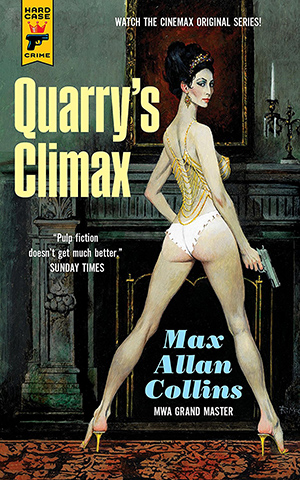
Comic Mix has a giveaway contest for a Blu-ray copy of the Quarry Cinemax show.

A wonderful write-up on the Blu-ray release of Quarry is at DVD Beaver, one of my favorite sites (and not a porn one, despite its name).

Finally, here’s another Quarry Blu-ray review (haven’t received a copy yet myself).

M.A.C.

Dinner With Perry and Della

January 31st, 2017 by Max Allan Collins

Barbara Hale is gone.

She was 94, so it’s not exactly a tragedy, but it still hurts. Few actresses have done more with so underwritten a part as Ms. Hale did with Della Street on Perry Mason. She brought humor and intelligence to the role, and her genuine connection with both Raymond Burr and William Hopper brought a sense of reality to a fairly ridiculous if enormously entertaining concept – the defense attorney who (almost) never loses a case.

I was lucky enough to meet Barbara Hale and spend some time with her. Here’s what happened.

Back in the late ‘80s, I got the chance to collaborate on a project with Raymond Burr. Now, coincidentally, I had for some time been collecting the old Mason shows on VHS, and reading the Erle Stanley Gardner novels as crime-fiction comfort food, even collecting Mason first editions. Barb was a fan of the TV show, too, so it was a mutual enthusiasm, which is always nice for husband and wife.

Getting the chance to meet Burr, and work with him, was a dream come true. I made three trips to Denver, where the Mason TV-movies were being shot, and spent a lot of time with Raymond (he preferred that to “Ray”). He was an interesting guy, warm and generous and puckishly funny. The high-end hotel where I was staying had a residential wing where Burr lived during production of the films. I went to his suite, knocked on the door, and he answered, wearing a railroad engineer’s cap and coveralls – he had an elaborate model railroad set-up that threaded through the various rooms of the apartment. And the trains were a rollin’!

He and I got along fine. The first trip we didn’t work – we just got to know each other, and he regaled me with tales of his long and fascinating, much-travelled life. I heard about the Ballets Russes, where his career had begun, and of such world figures as Madame Chiang Kai-shek, as well as his experiences touring with the USO in Vietnam. I told him we should just skip the idea of doing a thriller and put together his autobiography. But he was adamant that he would never write that book, after spending hours convincing me it would be important and fascinating. His bisexuality, which he fairly openly referred to in our conversations – his frankness was part of my acceptance as a friend – was something he never wished to discuss in public.

On the other two Denver trips, we worked – plotting an espionage thriller in the morning and over lunch, with me working several hours in the mid-afternoon in my hotel room to put our thoughts on paper, joining him again an hour or two before supper. Every meal I had on these trips was with Raymond.

One meal was particularly memorable. Barbara Hale was arriving to shoot the next Mason TV movie, which was about to begin production. Raymond asked me if I would like to meet her and go out with them for dinner at the best steakhouse in Denver. I would have gone to the worst diner in Paducah for a chance to do that. I called Barb and said, “Guess who I’m going out to dinner with tonight? Perry and Della!” She said she hated me, but sounded sweet saying so.

Barbara Hale would have been 66 at the time – two years younger than I am now – but I remember being almost startled by how lovely and young she seemed to me, and, frankly, sexy. She came across older on television in the Mason movies. There was a genuine chemistry between us, and the fact that I could make Della Street smile so easily was just about as good as it gets.

We definitely hit it off, and she was impressed that I knew about her career right down to her appearing in small roles in various RKO movies of the ‘40s, like The Great Gildersleeve entries. In the limo on the way to the steakhouse, sitting between her and Raymond like their overgrown child, I told Barbara how much I loved her in Jolson Sings Again. Raymond, with his ever-present twinkle, said, “Oh, I agree. She was wonderful getting down on her knees in blackface.” She giggled and batted his arm and he giggled back. These two loved each other. Was I really here?

At the steakhouse – where actor Tom Bosley (filming the Father Dowling mysteries in Denver) stopped by to pay his respects – we had a long dinner during which I questioned Raymond and Barbara incessantly about the original Mason show. I had brought along the hardcover first edition of a Mason novel that had Barbara and Raymond pictured together on the back cover – I got this signed by both of them. They had a great time reminiscing about the original show and I only wish I’d secretly recorded all of it.

The TV movie they were shooting, The Case of the Musical Murder, had Debbie Reynolds as a guest star, but she wasn’t around while I was. I did get to go on set several times and watch scenes being shot, and also had several nice conversations with William R. Moses, who had just begun playing Mason’s young assistant on the show. For the first nine movies, Barbara Hale’s son, William Katt, had played Paul Drake, Jr., and Moses was essentially replacing him. I didn’t know why and was tactful enough not to ask.

But I did, at our steakhouse dinner, tell Barbara in front of Raymond what a great job I thought her son had done in that role. She beamed at that. The next day, when Raymond and I picked her up at her suite for lunch, she took me aside and gave me a hug, and whispered, “Thank you for what you said about my son.” Katt, it turned out, had left the Mason movies for a (short-lived) series of his own, and apparently Raymond was not happy about it.

Still, the affection between the two performers was obvious. Raymond told me over lunch one day that he planned to end the series of movies with one in which Mason and Della finally got married. The films began to include genuine expressions of love between the characters, even a kiss or two (the original series had been much more coy about what was an obvious long ongoing relationship between boss and secretary).

Unfortunately the project with Raymond (and I do apologize for speaking of him so familiarly) did not go anywhere. The New York editor who had put us together wanted a mystery, and even suggested a courtroom-oriented one, with the world-hopping thriller we proposed not doing the trick. The editor clearly wanted something like Perry Mason or Ironside. Raymond Burr, with all his international interests and travels, wanted something wider-ranging and in the espionage field. I later learned that two other writers were put together with Raymond Burr and in each case the actor’s strong personality guided them to espionage, and each time the New York editor bridled.

Of course Perry and Della never got married. Raymond Burr’s death in 1993 pre-empted that.

While I regret I never shared the Burr byline on a book or even series of books, I still relish the memory of the collaboration.

After all, it’s not everybody who gets to spend an evening with Perry and Della.

* * *

Arrow is giving some info about Wild Dog’s origin. Still haven’t watched an episode.

Here’s a fun look at Mike Hammer in the movies and on TV (though the writer, who quotes me occasionally, does not seem to have read Mickey Spillane on Screen by Jim Traylor and me).

Here’s an article about the Quarry books and a discussion about what order to read them in, with several options.

Finally, here’s an essay that thinks Cinemax ought to give Quarry a second season. My bank account agrees!

M.A.C.

Snapshots of a Friendship

January 24th, 2017 by Max Allan Collins

I met Miguel Ferrer in 1987 at the San Diego Comic Con. I approached his friend Bill Mumy as a fan – not so much of Lost in Space as of his band, Barnes & Barnes, of “Fish Heads” infamy. Knowing he was guest of the con, I had brought copies of several CDs for Bill’s autograph, and – in line for something and being lucky enough to be right ahead of Bill and Miguel – I got the CD inserts signed. We chatted. Turned out Bill and Miguel were hardcore comics fans, in particular of the Golden Age, and collected the heavy-duty, expensive stuff – early Batman, Superman and Captain America, among many others. They had hung out with Jack Kirby, Bob Kane and Stan Lee.

I was enough of a comics celebrity, as writer of Dick Tracy and Ms. Tree, to gain immediate acceptance, and we went together to a dance in the ballroom of the Hotel Cortez (later Miguel did memorable location work for Traffic at this fleabag). The band was nothing special. In talking about Barnes & Barnes with Bill, I’d mentioned that I was a longtime rock musician myself, and somebody – probably me – said, “We could go up there right now and do better, cold.” (I’d gathered that Miguel was a drummer.) We’d been standing with the enormously tall and talented (and tall) Steve Leialoha, who said, “Well, I play bass.” I said, “Guitar, keyboards, drums, bass.” Bill said immediately that he would talk to con organizer Jackie Estrada about having us play next year. But of course we needed a name.

Miguel, like any good drummer, did not miss a beat. He said, “Seduction of the Innocent.”


Seduction of the Innocent, circa 1988

That very night Bill pitched us and got a commitment for the 1988 San Diego Comic Con. During the year that followed, Bill and I swapped song lists. We used my band Crusin’s song list as a jumping off point, picking the things that seemed to make sense, and Bill added some hipper tunes. So we knew what to work on before we gathered for our first practice.

A few days before the con, we assembled in Bill’s living room in his very cool Laurel Canyon house, and played through his stereo speakers, which were very powerful. And of course we fried them. In the future we would be either in a rehearsal hall or some other room the con provided, and amps would be rented to our specs.

I’m not sure whether we played “King Jack” that first year (Bill’s tribute to Jack Kirby) but we certainly did it by our second performance. And there was a second performance, because we killed at the first. The dance floor was packed, many of the dancers in costume decades before the term “cosplay” was coined. “Pussy Whipped,” another Bill original, was delivered in Miguel’s distinctive growl and was a big favorite. The ‘60s covers we did included “Mr. Soul,” “Cinnamon Girl,” “You Can’t Do That” and “We Gotta Get Outa This Place.” Also, “Knocking on Heaven’s Door” – Miguel again, assuming a singular poignance now.

At our first meeting, I didn’t really know who Miguel was. He’d done some TV and had a small role in Star Trek 3: The Search for Spock, and he’d filmed his breakout role in Robocop, but it hadn’t been released yet. During the year leading up to Seduction’s debut, Miguel got very hot and stayed that way through the ‘80s and ‘90s (and beyond). But he was always the most lovable, loving guy to his fellow band members. No attitude. Just great big smiles and wry humor.

We played half a dozen times at San Diego Con, with Chris Christensen – whose small label, Beat Brothers, issued our original material CD, The Golden Age – joining us around the third appearance. Chris was another hardcore comics fan and a versatile “casual” musician, meaning he played all kinds of music with all sorts of bands. When Miguel was drumming, he’d play rhythm guitar for Bill’s lead; when Miguel was singing, he’d play drums.


Seduction of the Innocent, Santa Monica Pier

My friendship with Miguel doesn’t exist in a linear way in my mind. I remember how much we connected – he was the first guy to call me “brother,” and he meant it. I heard some California expressions from him before they got into the national vernacular: “He’s toast,” and “Sweeeeet.” He was a mystery reader and both he and Bill became Nate Heller fans in a major way (Bill wrote a song called “True Detective” for the Golden Age CD). Chris was, too, and probably Steve…but Steve always looked like he loved everybody and everything.

Once Miguel was in Chicago for a shoot on a Scott Bakula movie – In the Shadow of a Killer – around 1991. I was in the city promoting something or other, and Miguel and I spent several evenings together, with late-night conversations on everything from how good Diana Krall was to what it was like playing drums for Bing Crosby (which he had on Crosby’s final tour)(he also played drums on Keith Moon’s solo album). His famous father, Jose, was a big mystery fan too, and Mig got his dad on the phone to introduce me to him – that’s right me to him. Mr. Ferrer was impressed that I was friends with Mickey Spillane – can’t remember much else, just how wonderful it was having that warm, familiar voice in my ear.

Miguel had an afternoon off from the Bakula shoot and I had arranged a tour for us through the secret rooms beneath the Green Mill Café. The latter looked then as it did decades before (and probably does now) – a green-hued deco den of iniquity. As it happened, a comic book shop was next door and the eccentric owner, whose name I will not divulge (though he’s now deceased), had promised the tour. It had been set up weeks in advance.

But when we arrived, the comics shop owner – let’s call him Joe – was not to be seen. It took some talking, but the clerk revealed Joe was downstairs, where he’d been for over a week on a bender. Miguel and I exchanged glances, but gave each other what-the-hell shrugs. We found Joe slumped over a table with a glass and a whiskey bottle and a magnum revolver on it. There was a cot and a little refrigerator, but mostly bare cement.

Joe snapped awake, recognized me, remembered the promised tour, bolted to his feet and, issuing us orders, went quickly through a doorway into the basement’s nether reaches. Miguel and I exchanged glances and followed. After all, the gun had been left behind.

Through several chambers we went, including an ancient men’s restroom with urinals lined up St. Valentine’s Day Massacre style, while Joe turned on hanging bulbs along the way, leaving them swinging in memory of Psycho. He babbled about this being where Capone’s boys went during mob wars and did so while moving very quickly. We could hardly keep up. At one point, Miguel whispered, “Are we going to die down here, Al?” I said, “Maybe. But don’t worry – with the rats, they’ll never find us.”

Somehow the tour ended, and our lives did not. Anyway, we were back above ground.

One of Seduction’s most memorable early gigs was at the Santa Monica Pier in the building with the famous merry-go-round (another was when Wildman Fisher sang “Merry-Go-Round” with us at a San Diego con appearance, but that’s another story). We were joined on some tunes by Shaun Cassidy, who was a nice guy and strong performer.

Prior to rehearsing in LA for the gig, Barb and I were invited by Miguel to stay at his mother’s house. His mother – Rosemary Clooney – would not be home; she, too, was gigging. We had the big house in Beverly Hills to ourselves, and we gingerly peeked into an expansive living room with a picture of Bing on the piano and the ghosts of Sinatra and how many others lingering among expensive furnishings that dated back decades. There was admittedly a Norma Desmond feel to the place. We’d been asked to answer the phone, and Barb did – taking a message from Rosie’s friend Linda Ronstadt.

Before our stay ended, Rosemary came home and, with Miguel at her arm, gave us a tour, including the living room. Oh, yes, all those famous people had been here many times, sometimes singing around the piano. She was as sweet and down-to-earth as my own mom, giving us copies of her latest records. Later, she was at the stove making marinara sauce, and my Lord it smelled good. But Miguel and Barb and I were on our way to a comic-shop gig.

In late night hotel-room conversations, the topic of working together often came up. We each said to the other, “If at the end of our days, we haven’t done a film or movie together, we should kick ourselves.”

Miguel and I talked seriously about having him play Heller in a movie – my novella, “Dying in the Post-war World,” was written for him in lieu of a screen treatment. Miggie was friends with a screenwriter who’d had a big success and wanted to move into directing, and – on a trip to LA specifically for this purpose – I took an afternoon meeting with him in Miguel’s little Studio City bungalow. But after we’d talked for an hour or so about Heller, the screenwriter said suddenly, “You know what we should make? A western.”

Miguel and I traded glances – his seemed to speak volumes about the disappointments and absurdities that he dealt with day-to-day in that town. Back to Iowa.

Which is where Miguel almost appeared in Mommy as Lt. March. He accepted the role on the proviso that if a big-paying gig came along, he could bow out with just two weeks notice. I was fine with that, and he allowed me to use his name and picture in our preproduction publicity, and gave us a letter of intent for fund-raising. A major film came along, and Miguel had to bow out, but he paved the way for Mark Hamill to take the role. Mark was another hardcore comics guy and very close to Bill and Miguel, and I’d spent some time with him at a couple of comic cons – a smart, funny man. (As it happened, Mark dropped out a week from the start of the shoot because of a conflict with voiceover work. We were able to secure Jason Miller for the role.)

At the risk of further name-dropping, I have to mention Miguel’s good friend, Brandon Lee. Brandon loved being around Seduction of the Innocent, and he played roadie for us at several gigs, and partied with us afterward. He seemed to take to me and we got along great. Miguel turned him onto the Quarry novels and Brandon loved them – called me on the phone to rave, once. I asked Miguel, “Why has Brandon taken to me so? There are those who can resist my charms.” Miguel grunted a laugh and said, “Simple, Al. It’s ‘cause you never ask him about his father.”

Only later did I realize that with Miguel any interaction or talk about his famous parents had come from his end, not mine.

Seduction shot a video of “The Truth Hurts” for the Golden Age CD release, and Brandon was in it. Not sure that still exists – it was good.

Just days before we were scheduled to play at WonderCon, Brandon died tragically on the set of The Crow. Bill and Miguel had to cancel because they were to be pallbearers. Steve, Chris and I appeared with Crusin’ guitarist, Paul Thomas, as “Reduction of the Innocent.”

I had a small falling-out with Miguel when we hadn’t gigged for a while. He and Bill had a more serious, real band going – the Jenerators – and in an interview, Miggie jokingly dismissed Seduction, and said something like, “Max Allan Collins is lucky he’s a great mystery writer, ‘cause he couldn’t make a living as a musician.” I didn’t like that – I had in fact made a living as a musician for a while – and I called him on the phone about it. He heard me out and we had a typically warm, laughter-filled conversation.

But I learned through the Seduction grapevine that I was “in the cornfield,” where banished friends of Bill and Miguel went (a reference to Bill’s famous Twilight Zone episode, “It’s a Good Life”). The two friends would refer to those who’d got on their bad side by saying they were in the cornfield. I understood what had happened. Miguel was very non-confrontational, while I was and am somebody who has to deal with things right now or they’ll eat me alive. Also, Miguel was a star, and while he never played that card, I had stepped over a line.

When we got offered another San Diego con gig, I was afraid I’d jinxed it. Bill didn’t want to play without Miguel, even though we had done so once when Miguel again got a last-minute movie role. But Miguel said he was in. And when we rehearsed for the gig, it was clear all was forgiven. After the first rehearsal, I apologized, embarrassedly, and Miguel said “Forget it, brother,” with a grin and a shrug.

I had a habit, stepping down off the stage after a night that felt particularly good with the band, of quoting my late friend Paul Thomas: “Rock ‘n’ roll happened.” Bill and Miggie always kind of laughed at that, good-naturedly. But I to this day say it after a good Crusin’ gig. Seduction blew the roof off the dump at the San Diego con appearance. And as we came down off the stage, Miguel came over and put his arm around me and said, “Al! Rock ‘n’ roll did happen.” And he grinned that wonderful grin. It was a kind of apology, but it was much more than that. It was love, brother.

Sweeeet.

M.A.C.

Okay, So Maybe Movies Aren’t Better than Ever

January 17th, 2017 by Max Allan Collins

Before I briefly chat about what I’ve been up to on the storytelling front, here are reviews of two movies I endured this weekend.

Live by Night – Where shall I start? This is a terrible movie. It looks great, and I wanted to like it – it’s full of old cars and lots of cool wardrobe and art direction, just the kind of production values I’d like to see lavished on a Nate Heller movie. Unfortunately, this is the kind of lavish dud that will make it hard to get a Nate Heller movie made, because the Hollywood boys and girls will remind me how poorly Live by Night did at the box-office.

I’m not a Ben Affleck basher. He’s done some very good things, like Argo and The Town, and…well, like Argo and The Town. He’s a pretty fair Batman, too. Here he is a multiple threat, and I do mean threat, as actor, director and writer. I have no idea whether the source novel by Dennis Lahane is any good – I don’t read him. Some pretty fair movies have been made from his stuff, like The Drop and Gone Baby Gone, though I disliked both Shutter Island and the hammy Mystic River. My hunch is that the novel here is likely better, which would not make it good.

Clearly the novel was longer, because this has so much expository voiceover, the telling outweighs the showing. No characters take hold, no scenes develop sufficiently, and the stupidity of the plotting is at times mind-boggling.

For example. Affleck is secretly having an affair with the top gangster in Boston’s moll; when the gangster goes out of town, however, Affleck openly cavorts with the moll in public, and then is surprised when the gangster finds out. For example. When the film lurches into a Florida setting, a dumb-ass KKK leader is bombing Affleck’s nightclubs and wantonly killing people in the process; Affleck asks the dumb-ass to meet with him at Affleck’s own casino construction site, and then the dumb-ass is shocked when Affleck’s men pour out and kill him and his own goons. There are half a dozen scenes with set-ups that moronic.

The best moments are throwaways, as after the dumb-ass-gets-killed sequence when Affleck argues with a crony about who accidentally shot him. Only then does Affleck himself (and the movie) come to life. Elsewhere he goes beyond underplaying into a sort of mobile coma. He wears lots of hats, and I don’t mean director/writer/star, I mean hats – tan fedoras, gray fedoras, white fedoras, yellow fedoras, purple fedoras. I see a drinking game coming!

Two women are at the center of the story – the Bonnie Parker-type moll whose betrayal sends Affleck scurrying to Florida to avoid the wrath of the Boston mob boss – and a Cuban girl whose brother is in the rackets with Affleck. Though the latter is portrayed by Uhura herself, Zoe Saldana, and the former by usually reliable Sienna Miller, neither character makes a dent in the proceedings…and they are the two motivators in sleepy Affleck’s life. Elle Fanning as a nice-girl-turned-drug-addict-turned-evangelist, does better, but her role is so fragmented that it too never quite adds up, though its importance is also key to what little story we perceive.

The moral seems to be: when you’re making a movie, don’t wear too many hats, literally and figuratively. Also, when you’re doing a period piece about the twenties, don’t sing a snippet of “Sugartime,” a song from the late fifties. But it’s almost worth seeing for a howler about Hitler that comes very late in the proceedings: “Some little guy in Germany,” he says in voiceover, “was gettin’ people all excited. But they weren’t gonna go to war over him. No percentage in it.”

The Edge of Seventeen – This is a tricky one. It’s very well-made and nicely acted. The dialogue is frequently witty. Rotten Tomatoes gives it a 93% Fresh. But there’s nothing very fresh about the story, which is that a nerdy girl (Hailee Steinfeld) has a crush on a bad boy and doesn’t realize the nice smart guy who sits next to her in class is a better prospect. As if that wasn’t enough, the nerdy girl is portrayed by a lovely young actress, more likely to be prom queen than an outcast. On the other hand, she does behave like an asshole throughout, which doesn’t help us like her as a protagonist. Nor does the fact that she lives a privileged, cushy upper-middle-class life. Also, after she accidentally sends the bad boy an explicit text about wanting sex with him, she is surprised that, when they go out parking, he expects to have sex with her.

Additionally, she still doesn’t see the nice boy as a prospect even after he turns out to be very, very rich (he even has a bigger swimming pool than she does) (see how hard she has it?).

The secondary central conflict is rooted in her asshole-ishness: her nerdy outcast best-and-only friend (also portrayed by a lovely young woman) starts dating our heroine’s hunky brother, and this our heroine cannot abide! She is a flaming bitch to both throughout most of the film. Don’t you feel sorry for her? This is interspersed with occasional Breakfast Club self-exploratory soliloquies (as when her hunky brother reveals his life is also very hard, because he has to keep an eye on their emotionally troubled single mom, who by the way has a very, very good job, despite being an emotional wreck). Of course, she comes around to the worthy boy…after he invites her to a film festival where his incredibly professional animated “student” film unspools…and is about her!

How is this twaddle 93% Fresh? How is this a story that touches an average girl’s heart when the central character is a spoiled beautiful upper-middle-class brat?

The writer/director, Kelly Fremon Craig, does a professional job and some nice moments do happen, most with the Woody Harrelson teacher character. The producer is James L. Brooks, whose TV work (The Simpsons, Lou Grant) has often been stellar but whose movies (often acclaimed) have consistently missed me, and I include Broadcast News and Terms of Endearment.

So your mileage may vary.

* * *

This flurry of reviews lately – all positive last week, remember? – does not negate the fact that I genuinely dislike writing bad reviews. They are the easiest kind of thing to write, often filled with cheap shots (see above). For a long time I stopped writing them. I learned from my own indie movies just how hard the process is – that even making a bad movie is a tough, tough thing. I resigned from my movie column at Mystery Scene because of that. Then I wrote mostly good reviews at Asian Cult Cinema for several years.

Now, like a drunk falling off the wagon, I find myself writing bad reviews again. Why? It reflects a level of frustration that I feel as someone who loves movies, and who goes to a lot more of them than most people. Because I’m in Muscatine, Iowa, I often miss the art movies that are highly touted, but often when I see those, I am no more happy than when I see Hollywood’s standard fare. Art movies, indies, have become a kind of genre in themselves; that includes a lot of European stuff.

I am older now, and harder to please. I have quoted several times what the beautiful and wise Barb said when, as we watched a lousy Italian western at home, whether we would have stayed through the entire movie in the theater, back in “the day” (the ‘70s or ‘80s). As I shut off the Blu-ray player, she said, “Yes, but we had our whole lives ahead of us then.”

Truer words.

* * *

I am working on a Quarry graphic novel, which Titan will publish in four issues and then collect. Don’t know the artist yet, though I approved several based on samples.

It’s very, very hard. I have been away from this format for a while, and the story takes place partly in Vietnam in 1969 and then back in the America of 1972. Providing visual reference for the artist has been a dizzying, daunting task. A 22-page script runs to 60 pages with panel descriptions and links to reference photos.

I doubt I will do many more such projects. Prose is far less taxing.

* * *

The Rap Sheet takes a look at the Black Dahlia case, and has nice mentions of the Nate Heller novel, Angel in Black.

Here’s info on the upcoming Blu-ray and DVD of the Quarry TV series.

M.A.C.