Archive for the ‘Message from M.A.C.’ Category

Sam Spade News & A Fruitcake Near-Rave

Tuesday, April 28th, 2026

I’m pleased to announce I’ve signed with Hard Case Crime to do two more Sam Spade novels.

Launching a new Spade series wasn’t my intention in writing Return of the Maltese Falcon. I merely wanted to be out there first with a sequel to the classic original, now that it was in the public domain, and was presumptuous enough to think I could get it right.

As I’ve mentioned here, when I finished writing the book, and was pleased with it, my wife Barb warned me to brace myself – she said, Not everyone would like me appointing myself to a task that some might think ought never have been attempted. My thinking was, Somebody’s going to do this, and it might as well be me.

And I was surprised and pleased that the reactions were overwhelmingly favorable, generating some of my best reviews ever. A few naysayers weighed in, though were very much in the minority. Don’t get me wrong: I didn’t feel vindicated, I felt relieved.

Only when I saw how well Return of the Maltese Falcon was doing did I begin thinking about writing more Sam Spade. Spade is a character about whom Hammett might well have written another dozen or two novels, like Gardner with Perry Mason, Christie with Hercule Poirot or Rex Stout with Nero Wolfe. And of course Hammett, before turning his back on mystery writing, had written three Spade short stories, plus there’d been the popular Spade radio show with Howard Duff.

But what came to my mind was offering my publisher a trilogy, the first of which would be the already existing Return. I found it interesting to suggest two more Spade novels, each separated by ten years or so – to see what Spade was up to in the war years and then the McCarthy-era ‘50s (which obviously have resonance with Hammett’s life).

I wrote a fairly lengthy proposal and Hard Case Crime’s Charles Ardai, with support from parent company Titan’s Nick and Vivian Landau and my editor Andrew Sumner, responded favorably. I am now about to begin work on Prey for the Maltese Falcon, set in 1939.

In some ways it’s more challenging than Return, which gave me the luxury of working within the parameters of the original novel – its characters, its locations, its themes. Now Spade is ten years older, and the case I’ve constructed takes him all sorts of places that the original novel and my sequel didn’t.

Wish me luck.

* * *

The UK’s Guardian has an excellent essay on the resurgence of interest in the private eye. It includes a nice reference to Return and me.

* * *

I was surprised and pleased to discover that the Overly Honest Reviews site has posted a terrific Death by Fruitcake review that I’ve been granted permission to share with you.

RAVING REVIEW: One of the best types of mysteries doesn’t pretend to be bigger than it is. DEATH BY FRUITCAKE leans into its small-town setting, its contained stage environment, and its personality-driven storytelling without trying to inflate the stakes beyond what the story can support. That restraint ends up being one of its biggest advantages. It knows the scale it’s operating within and, instead of stretching, digs inward into character, tone, and timing.

The setup is simple in the best way. A dress rehearsal collapses into chaos when a notoriously difficult actress drops dead mid-performance, and suddenly everyone in the room becomes a suspect. That kind of confined, single-location mystery has been done countless times, but what makes this one click is the attention it pays to the personalities circling the event. This isn’t about elaborate plotting or intricate twists stacked on top of each other. It’s about letting the audience sit in a room full of people who all have a reason to hate the victim and watching the tension build from there.

Paula Sands carries much of the story as Vivian, and what stands out isn’t just her presence but the way the performance embraces a slightly heightened delivery without tipping into parody. There’s a stiffness to her line reading at times, but instead of breaking the illusion, it almost feeds into the character. Vivian feels like someone who sees herself as more composed and authoritative than she actually is, and that disconnect becomes part of the charm. It’s not polished conventionally, but it fits the world the film builds.

Alisabeth Von Presley brings a different kind of portrayal as Brandy, and the contrast between the two performances becomes one of the film’s strengths. Where Vivian leans toward control and presentation, Brandy feels more fluid, more aware of the absurdity around her. The moments where she interacts directly with the camera could have come off as distracting. They’re used sparingly enough that they add personality instead of pulling you out of the story. It gives the film an edge, a reminder that it’s in on its own tone without constantly pointing it out.

The supporting cast fills out the ensemble, keeping the suspect pool engaging. No one is pushed into satire, but everyone is just exaggerated enough to feel distinct. That balance is important in a story like this. If the characters blend into one another, the mystery loses its shape. Here, each interaction carries just enough tension or humor to keep things moving, even when the narrative slows.

The investigation expands in a way that feels intentionally relaxed, but there are stretches where it could have used a sharper sense of escalation. Conversations feel a bit repetitive at times, suspicions shift without always adding new information, and the momentum dips as a result. It never stalls completely, but there’s a version of this that trims some of that repetition and lands with a bit more impact.

There’s a lightness to the humor that doesn’t undercut the mystery, and a sense of familiarity that works in its favor rather than against it. It feels like a story that understands its audience, especially those drawn to mysteries where the intrigue matters but the experience is just as much about spending time with the characters. The jokes land more often than not, and when they don’t, they still feel in line with the world the film has created.

The single-location setting becomes a strength rather than a constraint, forcing the film to rely on blocking, performance, and dialogue rather than on visuals. There’s a stage-like quality to everything, which makes sense given the setting, and instead of fighting that, the film leans into it.

What ultimately holds everything together is the film’s understanding of what kind of mystery it wants to be. It’s not chasing complexity for its own sake, and it’s not trying to reinvent the genre. Instead, it focuses on delivering a contained, character-driven story with enough intrigue to keep you guessing and enough personality to keep you invested.

There’s also an underlying appreciation for the setting itself. The small-town dynamics, the overlapping relationships, the way grudges and histories linger just beneath the surface, all of that feeds into the mystery without needing to be spelled out. It gives the film a sense of place that adds texture without complicating the narrative.

DEATH BY FRUITCAKE doesn’t aim for perfection. Its appeal comes from how comfortably it settles into its identity. The imperfections are part of the experience, but they don’t define it. What sticks is the chemistry between its leads, the playful tone, and the steady commitment to telling a story that fits its scale. It’s the kind of film that understands exactly what it’s offering, and more importantly, what it isn’t. And in a genre that often overreaches or overcomplicates itself, that clarity goes a long way.

Please visit https://linktr.ee/overlyhonestr for more reviews.

* * *

If you haven’t read Return of the Maltese Falcon yet, please do. And if you watch Death by Fruitcake on Prime or Roku or Apple TV, please leave a thumbs up if you’ve enjoyed it. And if you order the DVD from Amazon, a favorable review there would also be helpful.

Finally, just a reminder that True Noir: The Assassination of Anton Cermak is out as a 4-CD set now, and can be ordered here for only $23.37 (on sale from its usual $35.95) [Also in a single-disc MP3-CD for $19.47 or digital download for a mere $12.97! – Nate] It’s a full-cast star-studded nearly five-hour audio drama written by me from the first Nate Heller novel, True Detective, and directed by my pal Robert Meyer Burnett.

M.A.C.

Fruitcake on the Loose & the Great Cavern of Comic Books

Tuesday, April 14th, 2026

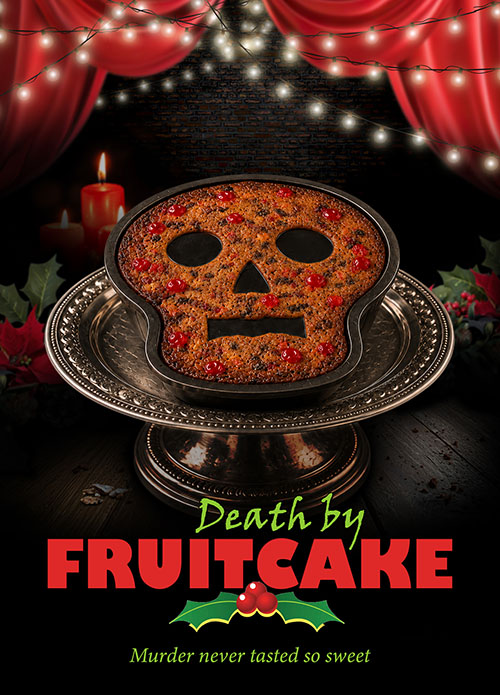
Our movie Death by Fruitcake, based on the mystery novels by “Barbara Allan”), is now available to stream FREE on Prime Video, The Roku Channel, and Apple TV.

Please support our effort. I am aware that not everyone who likes my work connects with (or has even tried) the Antiques novels that Barb and I write. Yes, they are cozy mysteries but with a subversive tongue-in-cheek edge. I love the books and enjoy being able to lean into the comedy, and the series must be pleasing someone because we just deliver book #20 in the series.

If you like it, leave a thumbs up or, if you’ve bought the DVD from Amazon, please leave a nice review.

* * *

Barb and I have spent the better part of a month in our basement dealing with comic books, hardcover and paperback books, DVDs and other assorted collectibles gathered over my lifetime. The collecting urge began probably when I was five or six, fed by a junky antique shop within easy walking distance where comic books could be traded two for one. It gave me admission to a world where the first Captain Marvel comics were still being published and Mad and the EC horror comics were available to rend and tear my childhood sensibilities.

The first comic book story I remember reading was in a coverless copy of Vault Horror: “All Through the Night” by Johnny Craig. That’s the one about a serial killer dressed as Santa Claus.

Three people shaped me (not including Johnny Craig).

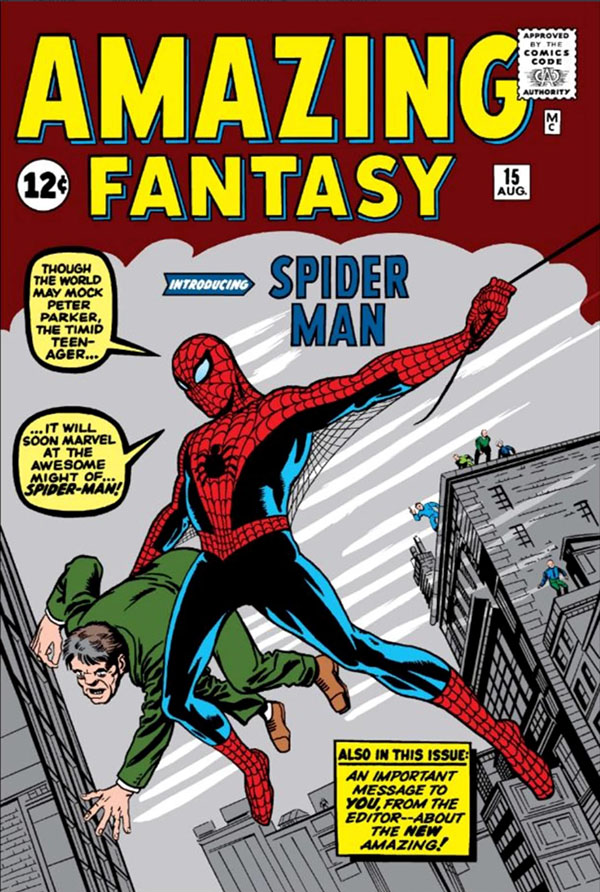
First, my mother read me Edgar Rice Burroughs Tarzan novels at bedtime, and encouraged my comic book reading. She had been a fan of the Dick Tracy strip when my father was in the Navy out of San Diego. Here is the cover of one of the first two Dick Tracy comic books I read at age six.

Of course my father was hugely instrumental (kind of a pun) in shaping me as regards music. For the first phase of his career he was a high school music teacher, celebrated as a chorus man throughout the state of Iowa (with his brother Mahlon, an incredible band man). This was in the early 1950s and Dad’s high school productions of Oklahoma and Carousel were among the first – if not the first, as the Des Moines Register claimed – such productions anywhere. He and a mentor of mine, Keith Larson, put on an original musical (Annie’s Musket) during this period.

I was in most of Dad’s productions, of which Carousel is the one I remember most vividly, because he arranged to have a working carousel on stage. He was an amazing vocalist and vocal teacher who gave up teaching to become an executive in industry, a career shift he did not love but paid well; on the side, he directed a national championship Elks male chorus for fifty years to exercise his creativity and stay sane.

Sidebar: in high school, as a sophomore, I was put in a vocal quartet (soprano, alto, tenor, bass) to try out for All-State, the winners being part of a massive chorus at a concert in Des Moines every year. Our young choral teacher – perhaps unaware that my cronies and I had mounted two musicals in junior high – said he couldn’t afford to spend time with us. He would be too busy coaching the three other quartets of upper classmen, who had a genuine chance of being selected All-State; but he was letting us attend the competition for the “experience.”

I went home, told my father, and he gathered my fellow quartet members (I was the tenor) and coached us, which exposed me first-hand to what a great teacher he was. We won State (the other three quartets did not) and our same quartet went on to win as juniors and seniors, as well – I believe the only quartet in the state to do so.

Not all was sunny between my father and myself. He went to college on a split sports/music scholarship, and was a huge sports fan. I was not. I was a little kid who did not get his growth till junior high kicked in. I went out for football, to please Dad, and did well. By high school, as a defensive lineman, I had the most tackles in the Little Six (our conference).

Why I liked football was that I could strike metaphorically back at the bullies who had made my childhood miserable. I was a scrappy kid, as a skinny good student in glasses had to be, and had something like half a dozen fist fights between junior high and high school. There was just something about my face, and attitude, that begged bullies to take a punch.

Still, in those days fathers and sons were rarely close, and I was closer to my mom than to my dad. He was quietly dismayed that I would go to movie matinees on the weekends with my mother and not stay home and watch sports with him. I was a story guy, a book reader, and had (and still have) little interest in watching people play games. I liked to participate in football, where I could clobber somebody and get away with it, and scant interest in watching it.

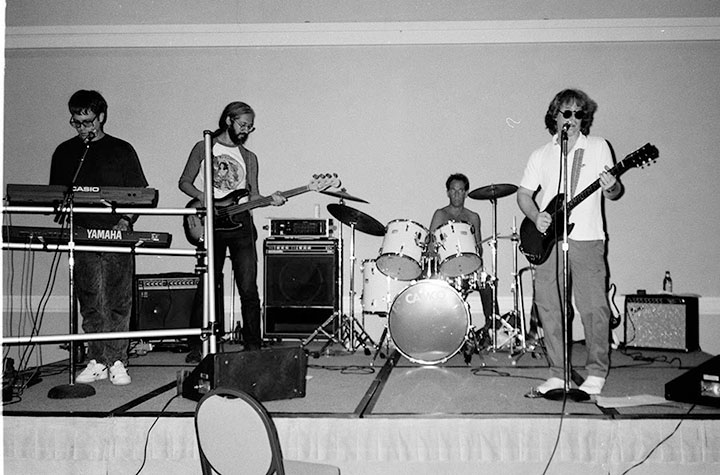
My father and I developed a much better relationship as adults. He was supportive of my rock ‘n’ roll efforts and got my band the Daybreakers an invite to Nashville because of a successful former student of his who became a country western recording artist (Jack Barlow); that led to our record contract with Atlantic’s Dial subsidiary. But I think my thematic obsession in my writing of fathers and sons, parents and children, flows from my uneasy relationship with Dad.

The other major influence on me, growing up, was my late uncle, Richard Rushing. My uncle was an insurance investigator who had ambitions to be a writer, and that likely planted a seed. He was funny, in a dark way, and that seed probably got planted in me as well.

In his basement he had a 1950s man cave, with a TV and a fridge of beers (an alcoholic, clearly, but I didn’t realize that till later). We watched movies on the little black-and-white TV and he would cackle, “It’s a gobbler!” when a flick was bad. Yes, I learned about some movies being turkeys from Uncle Richard. He had Playboy centerfolds on the wall – these were those early, discreet nudes; but this was still bold for the times. And, yes, another seed was planted in me.

I have three really vivid memories of Uncle Richard.

The key one had to do with the Great Cavern of Comic Books. When I was five or six, and obsessed with comics, we sat in my uncle’s back yard and he gestured, with beer can in hand, toward the exterior cellar doors of his little bungalow. He told me, his eyes gleaming, that through a passage therein was a tunnel leading to a massive cave where all the back issues of all the comic books were stored – not just Donald Duck and Superman, but EC horror and Mad and…any title a child in 1954 could imagine.

The existence of this cavern seemed doubtful to me, even at six. So I would beg Uncle Richard to take me through those outside cellar doors and prove his tale true. He would refuse. Simply too dangerous to put his favorite nephew at risk. Trolls and hounds from Hell guarded the passage, after all.

Within a year or two, I understood this was bullshit courtesy of my beer-guzzling uncle. But for years – even today – I could and can picture this treasure trove of four-color wonder.

The other vivid memory of Uncle Richard came when I was starting to write crime fiction at age 14 or so, very much in Mickey Spillane’s sway. My insurance investigator uncle showed me (inappropriately) photos of crime and accident scenes he had investigated. One was of a fat man who had drowned in his car, eyes bulging, arms reaching for the sky through the busted glass of the submerged windshield in which he was trapped and getting nothing but more water.

“That’s what death is really like,” my uncle told me.

The other memory is even worse. As the years passed, Uncle Richard’s mental illness asserted himself. I don’t know when this happened, probably at least thirty years ago; but I was called to the psyche hospital in Iowa City to be told how serious his condition was. Maybe I had to sign off or something, as a representative of the family. I don’t remember.

What I do remember is the sight of my uncle strapped down to a table, stark naked (as Mickey would say), and giggling and laughing hysterically. He confided in me, spitting as he spoke, that he had completely fooled these doctors into thinking he was crazy.

What has brought all of these memories swirling to the surface?

Well, as I said at the outset, Barb and I have been dealing with my sixty-plus years of collecting, and it’s been sobering and illuminating. For one thing, I discovered things I thought lost, like several zippered storage cases of CDs for the car (one consisting entirely of Christmas titles); last week I mentioned finding letters I thought were gone, like the nice one from Ross Macdonald that I have since tucked inside my copy of The Blue Hammer. For another, I’ve had to deal with unceremoniously dumping precious but now water-damaged items.

And I didn’t even know I still had my Rootie Kazootie 3D comic book.

It has been, and still is, a lot of work. I am waiting for word to come in a writing project and taking advantage of the down time to deal with this basement from heaven and Hell. Barb has been doing amazing things – just now she interrupted the writing of this to say she’d got our jukebox working! It has been dead for years, but thanks to her now is experiencing a late Easter resurrection.

Coming across a Dick Tracy comic book I know my mother bought me (the one pictured here)…finding the poster I made for Camelot, when in my junior year I played King Arthur, and made my father proud…I have finally entered the Great Cavern of Comic Books my uncle teased me with, with only memories stirred and no trolls or hell hounds. I feel like I have performed an autopsy on the life that I am still living.

And other than the dust inhalation and the coughing, it doesn’t hurt at all.

M.A.C.

Alisabeth Von Presley, Eliot Ness and the Basement from Hell

Tuesday, April 7th, 2026

This from Alisabeth Von Presley on instragram:

You guys!!! The movie I filmed last year is officially OUT and I’m screaming.

Death By Fruitcake is finally here!! I play the daughter of a local theatre diva, and together we accidentally (and very fabulously) get wrapped up in solving a murder… don’t worry, it’s chaos in the cutest, funniest way possible

You can stream it on Amazon or grab your own copy (which, obviously, you should).

Directed by the incredible Max Allan Collins. Truly one of the most joyful humans to work with. I loved every second of this experience with him and the entire cast & crew!!

* * *

Here’s Tim DeForest on Bullet Proof:

Eliot Ness #3: Bullet Proof, by Max Allan is the third of Max Allan Collins’ excellent hard-boiled series set in the 1930s and featuring Eliot Ness. It’s set after Ness’s Untouchable days, when he worked as Safety Director in Cleveland, running both police and fire departments.

Collins’ novels are fictionalized versions of cases Ness actually worked. In this case, he’s looking into labor trouble. A couple of smart racketeers are entrenched in important union positions, using this to extort money out of local business owners.

Ness’ problem is getting enough of the victims to testify, since doing so could be dangerous to their health. In the meantime, Ness recruits an old friend who is involved in the unions to help gather evidence. The friend is an old union hand, but recognizes that the racketeers aren’t doing the working class any favors.

Eventually, the situation escalates from vandalism and extortion to murder. There’s an attempt to hit Ness as well, but the top cop comes up with a clever plan to gather supposedly lost ballistics evidence and soon finds himself stalking a killer through a warehouse filled with plate glass.

It is yet another great entry in this great series. The story progresses logically and Collins presents Ness as a strong, smart protagonist. Characterizations of both good guys and bad guys are excellent.

It’s available here in a $10.99 trade paperback.

There is also a four-book collection of all my Ness novels in Kindle e-book format.

And Wolfpack has 16 of my novels (some with Mickey Spillane) as well as other e-book collections. If you haven’t read the three John Sand novels (Matt Clemens and I paying tribute to James Bond), the two Mommy novels, the Blue Christmas collection (with the novella that is the source of the film), or my pre-Antiques series collaborations with my wife Barb, this is where you’ll find them: https://wolfpackpublishing.com/collections/max-allan-collins

* * *

As I await hearing from one of my regular publishers on a book proposal, Barb and I have gone into Extreme Spring Cleaning mode.

To say our basement – home to many books, magazines, comic books, DVDs and laserdiscs – was overdue for attention would be a ridiculous understatement.

The shelves in what should be a library have become overstuffed and random, where for years they had been reasonably well-organized. Much of my Nathan Heller and other historical research lives there, until recent years decently curated. Now what should be an array of wonderful reading material looks like the Yard Sale from Hell.

Barb and I have spent most of two weeks on the project of sorting and culling, boxing up books and DVDs and magazines and comics to go to Half-Price Books and Davenport’s Source Bookstore. I admit to prefering the latter, because Half-Price Books is Complete Highway Robbery; but when stuff has gotta go, it’s gotta go.

This has involved going into nooks and crannies where previous books, comics and mags have been subject to water damage. These go unceremoniously into the trash. Here’s the thing about going through sixty years of collecting: you face not just your own mortality, but that of physical objects.

Sorting correspondence has been rewarding, however, with letters turning up from Chester Gould, Mickey Spillane, Ross MacDonald, Brian Garfield and (a huge stash from) Donald E. Westlake. Less rewarding have been decisions about which runs of magazines to keep and which to get rid of.

The difference between hoarding and collecting, particularly if you don’t collect carefully, is a surprisingly small one. Rob Burnett keeps his DVDs and Blu-rays and 4K discs alphabetized, and I bet Terry Beatty knows where every collectible he owns can be found.

I have always been good about not going overboard with multiple editions. I do have various editions of the Father, Son and Holy Ghost (Hammett, Chandler, Spillane), but mostly I keep only one copy of any book I love. And deciding what to keep that doesn’t fall into the “love” category, say a book you liked, or a not particularly good book by a favorite author, well…that’s where Barb comes in. She snatches me from the jaws of insanity and pitches what questionable item I’m contemplating into oblivion.

And I have to say she’s incredible. For example. Barb has, from the start, never minded me buying men’s magazines. She’s been beautiful as long as I can remember (going back to my crush on her in the fifth grade), and her self-confidence has never been shaken by paper images. We have pin-up paintings all over the house and she likes most and tolerates the rest. When our son Nate was a little kid, his friends would look around wide-eyed and say, “Does your dad like girls?”

But how many women would patiently pile copies of Hustler and Penthouse into box after box to take to be sold to a book dealer for pennies, nickels and dimes? Few, if any other wives, would. She even insists on loading up our vehicle with boxes of books, mags and comics, not wanting me to risk my heart condition.

And it’s true that I can only work for a couple of hours before either taking a long break or hanging it up for the day. This kind of sorting requires a lot of up and down and reaching for this or bending for that, which is hard for a guy whose meds all come with dizziness and balance side issues. If just you’re starting to feel sorry for me, which I sincerely doubt, my most recent check-up showed that I am in incredibly good health for somebody with so much shit wrong with him.

I have known for a long time that my possessions come seriously close to owning me. Now I am finally getting even with them.

And even at this stage – past the half-way point – our basement lair is looking more like a library and less like a embarrassment.

M.A.C.

Dashiell Hammett and the Short, Guttural Verb

Tuesday, March 31st, 2026

I caution the easily offended – and even those who are understandably offended – but what I have to say in today’s update will frequently contain a certain word that likely originated from Germanic or Old Norse languages (e.g., ficken, fokken), meaning “to strike,” “thrust,” or “move back and forth.” It has for centuries been a forbidden, rude word. And it’s going to appear throughout this little essay.

So buckle up, or fuck off.

I remember the first time I heard the word. It was during recess on the schoolyard – specifically Grant School here in Muscatine, Iowa, in the mid-1950s. It came from a particularly scruffy kid and I knew, from the glee with which it was spoken, that I had heard something special, and not in a good way. I inquired of a fellow classmate and was told, in no uncertain terms, that this word was one that could get a kid (scruffy or not) in a world of trouble.

By junior high (this was now the late fifties/early sixties), the word sneaked out from the locker-room lips of my fellow classmates. The first time I saw it in print was in the novelization of the original Ocean’s Eleven (1960). It startled me enough that I remember the specific instance and where I was at the time (study hall).

And I didn’t see it again in print for perhaps a year – possibly in a Harold Robbins novel. But I read a lot of sleaze in those days (and nights) and can assure you its appearances on the page was infrequent.

By high school, however, the word ran rampant. My group of guys had nicknames for each other that we found absolutely hilarious – of course one of us was Fuck-head, another Fuck-nose, yes Fuck-butt and the supremely offensive Fuck-shit, which had us in stitches. Hard to believe as it may be, I do not remember which “Fuck” designate I bore.

By high school graduation in 1966, “fuck” was damn near casual among my male crowd, and by community college and my U of Iowa days it was beyond common among all sexes. Athletes and hippies alike were sporting and snorting language that had begun creepy-crawling into the American vocabulary after soldiers came back from fighting WW2 overseas.

As a budding writer – I began writing short stories and novellas in junior high, and novels in high school – I was struck by how rare the word “fuck” appeared in print, even as it had wormed its way into more casual conversational use. But even in those days, “fuck” had weight. It made a point.

I took great pride in being one of the first writers to use “fuck” and “fucking” and “fucked” rather freely in my fiction. I may have been the first to use the phrase “Jesus fucking Christ” (you’re welcome). I was breaking down, or anyway helping break down, a fairly stupid barrier. I felt that people in my novels needed to sound something approximating how people actually talked. “Fuck” coming out of the closet lost some of the word’s power, but that struck me as all right.

And yet.

“Fuck” has become something lazy writers use far too often, particularly in films. Recently Barb and I went to Ready or Not 2: Here I Come, a sequel to (not surprisingly) Ready or Not. We liked the first movie and had a great time with the second one, too. We were fine with the violence and the mean-spirited fun – we knew what we were getting into, after all. Not everyone likes those movies, but we find them enjoyable dark comedies.

And…yet….

The dialogue, as is so often the case now, was just one “fuck” (and its derivatives) after another. It’s a tempting word to use. It has a history of power, even if it’s lacking in power now. It’s so much more satisfying than “damn” or even “goddamn,” since you land on a soft “m,” and who is impressed by “god” anymore, anyway?

And “fuck” has that wonderful “fuh” at the start and hard landing on the “k.” But that hard landing is dulled by overuse. The opening episode of For All Mankind’s fifth season – a solid, smart show – presents an alternate history of the space program in which everyone seems to live on the planet “fuck.”

I’m not talking about the act of, you know, fucking. Just the word. I still like to use it for that special punch. That unexpected kick. Only it increasingly packs a lesser punch, and it’s become more and more the refuge of writers who think the more salt you shake onto the meal, well, the tastier it’s gonna be.

In writing Return of the Maltese Falcon, I had great fun doing variations on Hammett’s way around using the then-forbidden word “fuck,” when gunsel Wilmer Cook insults Sam Spade – “The boy spoke two words, the first a short guttural verb, the second ‘you.'”

So to all you aspiring writers, whether of novels or screenplays or comics, my advice is: use some goshdarn restraint. Sprinkle the salt on your prose, don’t pour the fucking shit – it’s not a Winter sidewalk.

Anyway, it’s Spring now, so back the fuck off.

* * *

Some folks have asked about the major missing list from my recent couple of rounds of lists, so here it is:

FIVE FAVORITE MYSTERY WRITERS
1. Mickey Spillane
2. Dashiell Hammett
3. Raymond Chandler
4. Rex Stout
5. Agatha Christie
(number six is Erle Stanley Gardner)

One of the reasons why I say “favorite” and not “best” is that these are personal distinctions, not absolute opinions.

Let’s rearrange the list.

BEST MYSTERY WRITERS
1. Dashiell Hammett (from which everything noir flowed)
2. Raymond Chandler (the biggest influence on the genre)
3. Mickey Spillane (the writer who transformed the genre)
4. Agatha Christie (the greatest plotter)
5. Rex Stout (the most entertaining)

So while Stout comes in #4 on my favorite list, and #5 on my best list, I have no trouble admitting that I’d rather sit down to read a newly discovered Nero Wolfe/Archie Goodwin mystery than something by anyone else on these two glorious lists.

No further explanations will be offered (probably).

* * *

I am pleased to see that Road to Perdition (the film) continues to attract attention, particularly as a notable movie based on a “comic book.” These are worth checking out.

https://intheseats.ca/the-its-lists-comicon-special-top-non-superhero-comic-book-movies/

https://fanboyfactor.com/2026/03/movies-you-didnt-know-came-from-comics/

* * *

My buddy Heath Holland’s Cereal at Midnight YouTube videos are always worth a look. Heath and I have been doing frequent commentaries for Blu-ray releases for the likes of Kino Lorber and Imprint. We’ll be doing one this afternoon.

Heath recently interviewed me about my return to indie filmmaking, by way of micro budgets. This covers ground no one else has. You may find this worthwhile.

* * *

The True Noir event at the Putnam Museum and Science Center in Davenport, Iowa, has been rescheduled for May 28 and 29 (the last Thursday and Friday of May). On the first night we’ll be screening the restoration of the 1941 Maltese Falcon on the Putnam’s IMAX screen, followed by Robert Meyer Burnett (flying in from California – I believe he’s lining up at the airport now) interviewing me about Return of the Maltese Falcon. On Friday we’ll be presenting in the IMAX theater the opening chapters of our full-cast audio drama (based on my novel True Detective), True Noir: The Assassination of Anton Cermak.

Much more about this as the event approaches.

M.A.C.