
Chinatown Revisited

April 10th, 2012 by Max Allan Collins

At last a Blu-ray of CHINATOWN has been released, and it looks glorious. I haven’t listened to the commentary featuring writer Robert Towne and director (though not of this film) David Fincher. But the feature, on this upteenth visit by me, once again wove its spellbinding narrative.

As the author of the Nathan Heller novels, I was struck by how much I was influenced by the film, not in the obvious way of its being a period private eye film with a historical basis; but by two other, more subtle aspects of the film.

First, Jake Gittes is a rather typically cocky P.I. who is able to master his little corner of the universe. But when cast into the bigger world that is the corruption of the USA in general and L.A. in particular, he is out of his depth (“You may think you know what you’re dealing with…”/“Forget it, Jake – it’s Chinatown”). Heller was definitely influenced by the post-Watergate conspiracy approach of the film, and while Heller (like Gittes) always has small victories, he cannot triumph over the powers-that-be, whether government or mob. It’s significant in CHINATOWN that while Jake is pretty much in every frame of the film for its duration, he is finally, literally yanked out of the frame – and stripped of his ability to have an impact on the story – as its conclusion tragically unfolds.

Second, while Jack Gittes reflects Robert Towne’s respect for Raymond Chandler, Towne nonetheless set out specifically to make Gittes the opposite of Phillip Marlowe (this I confirmed in an interview online). Gittes takes divorce cases, he’ll sleep with clients, he’ll take a bribe, and…any of that sound familiar? I set out in TRUE DETECTIVE specifically to break every one of the rules Chandler set down in his “down these means streets” code. Towne, I have learned, essentially did the same thing.

Those of you who love CHINATOWN but who have dismissed its sequel, THE TWO JAKES (1990), should strongly consider watching the DVD of the latter after viewing the Blu-ray of the former. Whether you disliked THE TWO JAKES or avoided seeing it out of misguided respect to CHINATOWN, you need to give it a serious look. It works extremely well when your mind is fresh with the first Gittes film, as it’s a coda of sorts that is intertwined with CHINATOWN both on the plot and thematic level. On its own terms, it’s an intelligent private eye film, directed by Nicholson with restraint and sense of style and mood. As a ten years later continuation of CHINATOWN, the second film has resonance and substance.

Of course, THE TWO JAKES is not on the level of CHINATOWN. Nicholson studiously avoided any melodrama and even left some plot elements (including a killing and a great post-courtroom comeuppance for a Noah Cross-style villain) on the cutting room floor, after his initial cut was deemed too lengthy. Apparently Towne was unhappy with those cuts, but that doesn’t keep THE TWO JAKES from being a worthy, rewarding coda to the greatest private eye film of all time (yes, even better than KISS ME DEADLY).

For a film to be great, the gods must smile – everything must fall into place, all creative talents must be perfect for their roles (whether actor or otherwise) and at the top of their game. Luck and magic must happen. CHINATOWN originally had what is said to be a lousy score, and Jerry Goldsmith was brought in at the last minute to write (in a little over a week) what is now considered one of most memorable film scores of all time. THE TWO JAKES suffers from what is at best a serviceable score (by Van Dyke Parks), and at worst an intrusive one.

Nonetheless, it too deserves a Blu-ray. On my sound system, the unmemorable music swamps the dialogue; perhaps the Blu-ray format, with its excellent sound, would remedy that. But it took Paramount this long to release CHINATOWN, so….

And I suppose it’s too late to hope that Nicholson and Towne might get together one last time for GITTES VS. GITTES, the third film in the trilogy, derailed by the lack of commercial success for THE TWO JAKES (not intended as a coda, but a pastoral fugue of a second act). The trilogy was to be water (CHINATOWN), fire (THE TWO JAKES) and air (GITTES VS. GITTES). The third film would have been set in 1968 and deal with the end of no fault divorce, a reclusive Howard Hughes-type villain, and the LA freeway system. Call that one the greatest private eye film never made.

M.A.C.

Antiques Finish

April 3rd, 2012 by Max Allan Collins

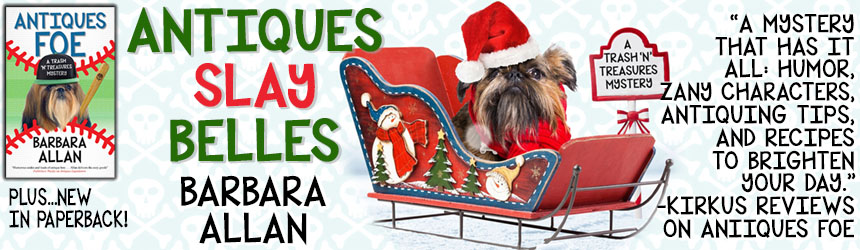
We finished and sent out ANTIQUES CHOP this week. The book was essentially complete by Tuesday afternoon, but we spent two more days reading and tweaking it. When you work on a book over time (Barb was on it a year, I was immersed in it for over a month), you get lots of little things wrong – everything from character description to plot points – and it’s necessary to make the end result not just satisfying, but consistent.

The final read-through is – except for plotting sessions – the only time Barb and I work on a book in the same room (my office). I read and mark up pages, and she enters them into the computer files, first checking to see if my changes/corrections/tweaks make sense to her. This tends to be a somewhat frantic but very much fun aspect of a book, particularly with the ANTIQUES series, because we wind up reading the funny stuff out-loud to each other, and laughing and laughing.

That’s because part of what we do in these books is try to top each other with funny stuff. It’s disturbing how easily it is for me to fall into the character of Brandy Borne’s eccentric diva mother, Vivian. Because the story involves two ax murders, the humor is at times darker than usual, which of course was fine by me.

Late this coming month (that would be April), ANTIQUES DISPOSAL will be out. I’ll share a few thoughts about that when the time comes.

In the meantime, I now face my usual post-project project: cleaning my office. At the beginning of a book, my work space is pristine; by book’s end, it’s a disaster site.

April will be spent on smaller projects – a Mike Hammer short story, a collaborative short story with Matt Clemens, another Fangoria Dreadtime Stories radio play, another DICK TRACY introduction. Also, finishing touches are being put on a new hardcover MIKE HAMMER comic strip collection for Hermes Press.

This is that “no rest for the wicked” you hear so much about.

M.A.C.

True Crime Kindle Sale (April)

April 1st, 2012 by Nathan Collins
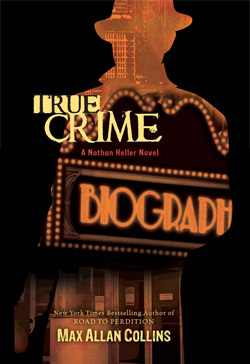
True Crime

I’m still over in Japan, so this will be a quick announcement.

Through the end of April, the second Nathan Heller novel, True Crime, is on sale for $1.99 on the Kindle store.

The entire backlist of Nathan Heller books is available on the Kindle store, and many of them also steals for under five dollars each. (True Detective, for example, is only $3.60 and a terrific place to start.) Paperback, audio CD, and MP3 editions are also for sale. I’m in the middle of listening to the audiobook of True Crime, and I can highly recommend Dan John Miller’s version of Heller.

Also, please remember to leave a user review, especially if you like it!

Shareable link: http://http://amzn.to/HGisVd

Sayonara for now!

Antiques Chop Talk

March 27th, 2012 by Max Allan Collins

Right now I am in the home stretch of my draft of ANTIQUES CHOP, the seventh “Trash ‘n’ Treasures” mystery that Barb and I have collaborated upon. I should finish this week (and I better, because April 1st is the deadline) (no fooling). Nate suggested that, while I’m in the midst of it, I provide a behind-the-scenes glimpse at the process.

Barb and I begin with a succession of business lunches where we first come up with the basic concept, and usually tie it to a title. The pattern of the titles are to have the word ANTIQUES followed by a punning word, and we have a list of these (continually growing). This time the title ANTIQUES CHOP sparked the premise (sometimes it’s the other way around), leading to the mystery revolving around an ax murder, an unusually gruesome crime for a supposed “cozy.”

We often look at “antique” crimes, which is to say crimes that occurred decades ago but are having latter-day ramifications. So I suggested we make an unsolved Lizzie Border-esque ax murder the centerpiece of the story, and wrote a faux entry about the crime for a non-existent true-crime encyclopedia. From there Barb and I began the back-and-forth process of coming up with a fairly detailed plot. We have to turn in a sample chapter and brief synopsis to our editor at Kensington (and get approval), so we have to have a firm idea of where we’re going before Barb gets started on her draft.

Barb works on that draft for probably six months, although that six months may stretch out to an entire year, because she isn’t always working on it – summers tend to be busy and that keeps her away from the work. Last year, for example, we went on a west coast book tour, plus there’s comic con and other distractions.

As Barb writes, I stay out of her way unless she has a problem or a concern about what she’s up to. Sometimes we discuss a plot point, and oftentimes we discuss it if she feels she has a need to deviate from the plot as originally conceived. Generally, though, I give her all the space she needs.

When Barb delivers her draft, it’s usually about 200 to 225 pages of doubled-spaced copy. My job is to expand and flesh out her draft, providing more dialogue and even more humor and generally apply what I laughingly think of as a more professional gloss. The end result will be 300 to 330 pages. I do my pass in a month or less, working hard and intensely, with Barb editing and suggesting revisions as I go (she reads it, and provides her notes, a chapter at a time). We do a lot of this over business lunches – just yesterday, on what was otherwise a day off, we discussed two plot points that needed shoring up in the chapter I just finished and the one that I will be doing today.

The final step is for me to spend a day or two re-reading the manuscript and marking up a hard copy with revisions, with Barb entering them in the chapter files. Then, common to all writers, we ship it (by e-mail these days) and hold our collective breath, hoping for a delighted response from the editor. On this series, we’ve been lucky to get that response pretty much every time. Occasionally there are rewrites, as on ANTIQUES MAUL where the editor felt the murder occurred too late in the mystery, and we reshaped the book so that it happened virtually on page one and then flashed back.

I said “final step” above, but of course there is much more to do – there will be a copy-edited manuscript to check, and at least one round of galley proofs. We tend to trade off on these assignments, with Barb doing the copy-edited manuscript and me reading the galley proofs. We divide the work that way because (a) I hate the copy-editing stage, since the Moriarty of my career is the Intrusive Copy Editor Who Stalks Me Under Various Names and Guises, and (b) Barb is thoroughly sick of the book by the galley proof stage and is content to leave that step to me.

Do we squabble? Not much. Hardly at all. I may get testy if, as I’m moving forward in my draft, Barb indicates (and she’s always right) that I need to go back and make a few fixes in a chapter that I had considered finished. This occurs, on the rare occasion that it does occur, early in the morning before I have had a chance to become fully human. Let’s just say, first thing in the morning, I’m more Quarry than Mallory.

So there you go. That’s how this particular flavor of sausage is made.

* * *

It’s gratifying to note that I received such a warm reaction to my defense of the film JOHN CARTER – which, let’s face it, was fairly shrill, since the premise of my piece was that anyone who didn’t like the movie was an idiot. Not only did my piece receive more comments than usual, a number of blogs provided links and made favorable comments on my take on this beleaguered film.

I am pleased to say that the early reviews on LADY GO, DIE! are coming in and, so far, are all favorable. The book received a very nice write-up in the often tough Publisher’s Weekly.

And there was a very gratifying (and I think perceptive) review from one of my favorite contemporary crime writers, Bill Crider, at his blog (perhaps the best mystery fiction blog out there).

Similarly, Ron Fortier – another strong contemporary scribe – has written a LADY, GO DIE! review that appears at several blogs, including his own Pulp Fiction Reviews.

The Brandywine site continues to work through the Nate Heller backlist, and this time FLYING BLIND is discussed.

QUARRY’S EX has picked up several, slightly belated (favorable) reviews, like this one at Books Are For Squares and this one at Pulp 300.

Here’s a thoughtful new look at the film version of ROAD TO PERDITION.

And here’s a guy who says he’s addicted to my books. I have to wonder if he discovered Nate Heller through the Amazon reprint series, who essentially gave TRUE DETECTIVE away (for under two bucks) for a while there. You know, the drug dealers really had something with their “first one’s free” approach.

M.A.C.