
I haven’t written about Mickey Spillane here for a while.
For latecomers, I started reading Mickey and Mike Hammer when I was twelve or thirteen. Private eyes were all over the TV in those years (1958 – 1960) and Mickey Spillane’s Mike Hammer was one of the first, along with Perry Mason – Peter Gunn, 77 Sunset Strip and many others joined them soon.
I already was a kid who liked to read the literary sources of movies and TV I’d enjoyed, and most of the private eyes had literary roots. I quickly discovered Dashiell Hammett, Raymond Chandler and Mickey Spillane. They became, and remain, my pulp pillars.
Even at that early age I could see the fascinating differences between them – how Hammett was spare, how Chandler was literary, how Spillane was visceral. And I relished those differences.
But what surprised me, as I researched the three writers at the library, was how Spillane was viewed with disdain and even disgust. That research revealed that Mickey was the most popular of the three, and for a time had been the most popular in fiction period. Why, then, was he a pariah?
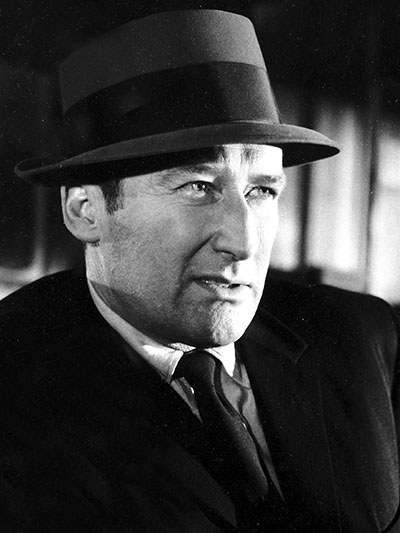
Mickey Spillane
It became clear, over time, that it was Spillane’s perceived political stance – a conservative one – that turned the nicer murder mystery community against him. Chandler was openly contemptuous of Mickey, dismissing him as a comic book writer.
Well, that may have been part of why I liked Spillane. I was not aware that his professional career had largely been one of a comic book scripter before he turned to the mystery writing game. But I was a comic book kid, a consumer of comics and even a collector, so Spillane spurred my all-in-color-for-a-dime blood.
What I wasn’t was political – at 13 or so, I had little grasp on politics. Later I began to question being a hereditary Republican, having grown up in GOP household; and by early college – after a flirtation with Ayn Rand – my burgeoning politics had definitely moved left.
That hadn’t changed my opinion of, or love for, the work of Mickey Spillane. I’d had a seemless transition from Mickey’s first six bestsellers (1947 – 1952) and his multi-book comeback in 1960. (I had discovered Ian Fleming in between.) I was familiar enough with Ayn Rand to know that she had sparked his four-book series about reactionary secret agent Tiger Mann. But I never thought of Mickey’s work as anything particularly political.
Today, as I see commentators about noir fiction talking dismissively about Mickey, I see that politics is a big part of it – politics and perceptions of him and his work coming from people who have read little or none of it. The majority of the casual scorn heaped upon Spillane inevitably talks about Mike Hammer in terms of fighting “Commies.”
The first six Spillanes (I, the Jury through Kiss Me, Deadly) were the enormous bestsellers that put him on the map. One of those books has Hammer taking on Russian agents – the glorious One Lonely Night. The rest find him taking on gangsters and psychopaths and other apolitical foes.
The next batch of Hammer novels, starting with The Girl Hunters (1961) deal on occasion with foreign foes in a very Ian Fleming sort of world, indicating Spillane was trying to keep up with the market he’d turned his back on. These novels are not particularly “Commie”-bashing, although the Dragon is a KGB agent in The Girl Hunters. Again, Mickey seems to be nodding to his new competition: Ian Fleming.
And yet the critics of Spillane and Hammer speak only in those anti-Communist terms – an easy mistake if you are criticizing Mike Hammer’s creator without having read him much or at all. None of these critics seems to have noticed that the villain of one of the key early novels is plainly based on Joe McCarthy.
It’s all snobbery. Hammett and especially Chandler are designed for readers who see themselves as aficionados of superior mystery fiction. Spillane clearly has a working-class audience in mind with his blue-collar hero.
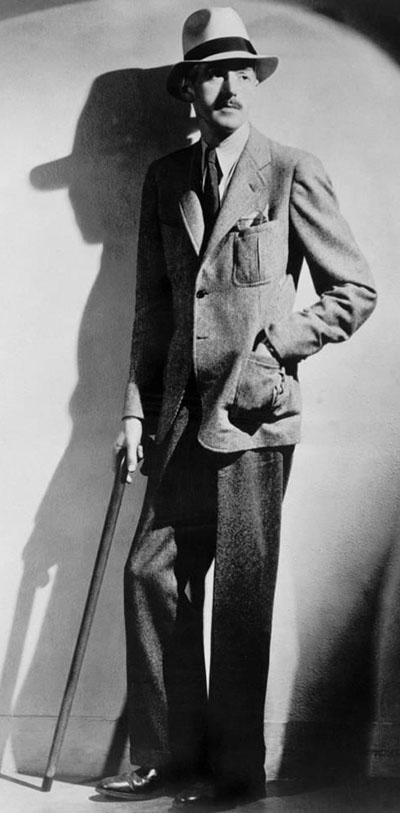
Dashiell Hammett
All of that was beyond me as a young reader, but I see it now. Hammett was one of the founders of the feast that Hemingway regularly served up (I happen to prefer Dash to Ernie), a spare style that reflected a no-nonsense view of the world; after all, Hammett had been a real-life PI. Chandler, schooled in Great Britain, created a fantasy detective, a chess-playing tough guy who tossed off one fancy simile per page like alms to the poor.
And I love both Hammett and Chandler.
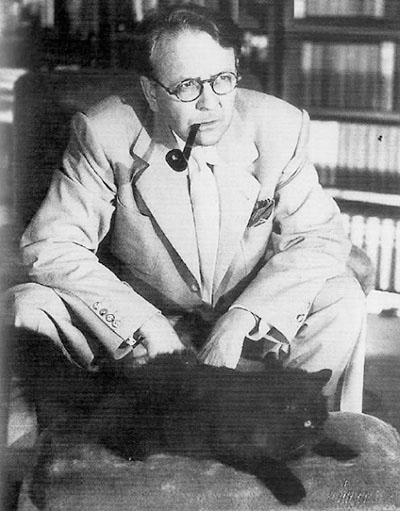
Raymond Chandler
But the pulp majesty of Mickey Spillane is what drew me in to the genre – me and a couple of generations of readers. This is how you grab a reader (or customer, as Mickey put it):
Somehow I had managed a sweeping curve around the babe. For a few seconds she had been living on stolen time because instead of getting out of the way she had tried to stay in the beam of the headlights. I sat there and let myself shake. The butt that had fallen out of my mouth had burned a hole in the leg of my pants and I flipped it out the window. The stink of burned rubber and brake lining hung in the air like smoke and I was thinking of every damn thing I ever wanted to say to a hairbrained woman so I could have it ready when I got my hands on her.
That was as far as I got. She was there in the car beside me, the door slammed shut and she said, “Thanks, mister.”
Many of the critics of Spillane do so while praising the film version of Kiss Me, Deadly (which lacks Mickey’s characteristic comma). But they aren’t familiar enough with the text to know how, in certain respects, faithful the film is to Spillane. We see Hammer as the world sees him, which is not entirely admirable; but we also experience that paperback world that surrounds him, that noir universe the film inhabits but that Mickey created.
Consider the opening of One Lonely Night:
Some place over there I had left my car and started walking, burying my head in the collar of my raincoat, with the night pulled in around me like a blanket. I walked and I smoked and I flipped the spent butts ahead of me and watched them arch to the pavement and fizzle out with one last wink. If there was life behind the windows of the buildings on either side of me, I didn’t notice it. The street was mine, all mine. They gave it to me gladly and wondered why I wanted it so nice and all alone.
How many times have you seen somebody say that Spillane was a lousy writer? Even those who grant him storytelling gifts like to dismiss him as some kind of literary lowlife.
So it is about politics in the end.
The kind of politics that dismiss, that condescend, that judge without consideration. I am happy my politics weren’t formed when I met Mickey. And I am here to tell you that Mickey knew my politics and his were not aligned. Of course, Mickey had become a Jehovah’s Witness decades before and politics was off-limits in that branch of faith.
But he was conservative, all right. And I was a liberal.
We never talked about it. But he entrusted to me his unfinished manuscripts – someone he knew to be liberal, but who understand his famous character. And you know what? He was an artist and didn’t give a damn about politics.
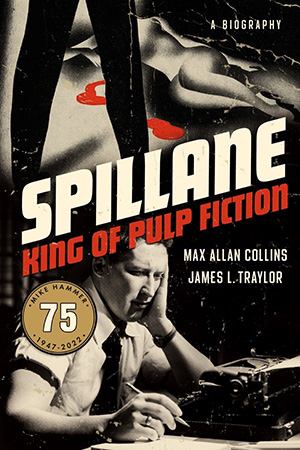
My pal Jim Traylor and I wrote Mickey’s biography for Otto Penzler at Mysterious Press, Spillane – King of Pulp Fiction. You can get it here.
Here’s another health update.
I wound up back in the ER last week with another of those attacks that I guess are called aphasia – spells of an inability to talk coherently, even using made-up words while at the same time maintaining a more or less mental clarity.
One attack was diagnosed as T.I.A., which is a minor stroke. That I’ve had several recurrences is disturbing, but they appear connected to the two ablations I’ve had – the spells have followed in a day or two, and then disappeared.
We are looking into this and related stuff – in both instances, I’ve been diagnosed with urinary tract infections. Right now I’m recuperating from the most recent heart-related ablation, which I’m told will take a month or so. I am in no pain but require a lot of sleep, and I am definitely slowed down.
Barb has been great. She is truly unbelievable.
And your warm good wishes are much appreciated; but I assure you we’re on top of this.
M.A.C.
Tags: Mickey Spillane
Best wishes on a full and speedy recovery! My grandpa used to say, “It’s not a-shame to get old. It’s dammed inconvenient though!” Absolutely loved him and he is the one that introduced me to Mickey Spillane by buying boxes of paperbacks at auctions of the old traditional fashion.
It is awesome to have a spouse who supports you Max. I too have a wife that takes care of me or tries to. Her health is not good either. She is an avid vivacious reader. Makes my interest pail in comparison because she reads so much quicker than I.
God bless you and yours.
Your piece on Mickey today is just what I needed. I love that you and Mickey were politcal opposites, but it didn’t kill your relationship. We need more of that these days.
Wishing you a full and speedy recovery.
Max,
Thanks for the Spillane post. Please feel better soon.
Al,.my best wishes to you on uour health challenges. I love reading your blog each week!
Nice article. I remember that, The Long Lonely Night being about him battling the commies, lol. The others I’ve read all are all more varied. I believe I remember also reading that he sorta based Hammer on a Newburg, NY, police sergeant he knew. There’s still neighborhoods of Newburg that are real shitholes to this day.
I also grew up watching the TV Detectives when they came on the tube, but I never watched them religiously, I would catch Peter Gunn, 77 Sunset Strip, Hawaiian Eye, Mr. Lucky, by flipping the channels. I was only 8 in 1960. I could only stay up when the folks were gone. I’ve since bought Mickey Spillane’s Mike Hammer, & Johnny Staccato, Dragnet, and Naked City, and been watching online M Squad and The Lineup. When I discovered that Frank Kane wrote a lot of the scripts for the McGavin version of Hammer I went and read all the Johnny Liddell PI novels I could find, too.
The others Hammer novels I’ve read all are all more varied. i believe I remember also reading that he sorta based Hammer on a Newburg, NY, police sergeant he new. There’s still neighborhoods of Newburg that are real shitholes to this day.
Hope you feel better soon.
Judas Priest ! Best recovery wishes, sleep sounds like a fine ‘prescription’. You could not find a better treasure than Barb. / And the essay on The Mick is deluxe !