
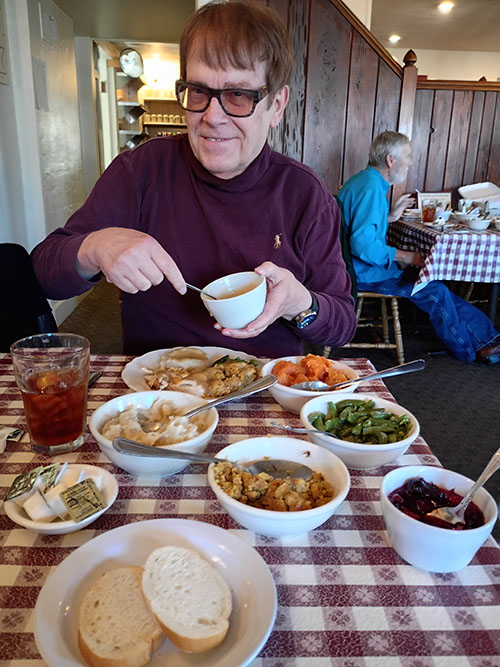
How I spent Thanksgiving.
You only get a picture of me chowing down because Barb would not approve the one I took of her, despite her looking incredibly lovely.
We had a wonderful day, though Nate and family were off with the in-laws in Texas, making for a rough ride home, long and snow-threatened. They’re home safe, though…and we’re really thankful for that.
Thanksgiving afternoon we took in Wake Up, Dead Man, the third Knives Out movie, which is headed very soon to Netflix. Kind of a shame, because it looked great on, and benefitted from, a big screen and great sound. Good movie, maybe the best of the three. I had it half-figured out, thanks to a literal Agatha Christie clue.
This week I share with you the interview by David Spencer with me for his forthcoming The Novelizers, 2nd Edition, very much expanded. The interview covers my movie and tie-in writing and how Lee Goldberg and I formed the International Association of Movie and Tie-in Writers.
MAX: As the various organizations in the various genres were ignoring media tie-ins, it seemed to me there should be a place where writers of novelizations and TV tie-ins could be honored for their best work. An award was the obvious central issue, but also connecting the writers in this difficult and unfairly ignored (and even maligned)
field.
What brought you and Lee Goldberg together in this endeavor?
MAX: I’m fuzzy on this, but I think Lee approached me, saying he and I were having the same idea simultaneously, and we’d be stronger going forward together. I agreed, and we did.
What was involved in getting the word out to other tie-in writers?
MAX: Lee and I reached out individually to writers we knew who worked in the field. A good number, like the late Peter David, were comic-book writers and I knew them personally from San Diego and other cons. Also, that con (and others) would have panels of writers who did tie-ins, and we’d hook up that way. Word spread quickly.
How did the architecture/organization of the association’s moving parts develop?
MAX: Fairly naturally. I’d been involved with the Private Eye Writers of America and we used that, at least initially, as a starting point. Also, both Lee and I were familiar with the Mystery Writers of America. We kind of combined ideas from both the PWA and the MWA.
What draws you to tie-in writing, still? It’s no longer as rare for a high-profile, mainstream writer (especially out of the science fiction category) to be regularly associated with tie-in writing as it once was, but I think you may nonetheless be among very few who walk along both roads with equal industry profile and professional enthusiasm (I think of you in the tradition of Robert W. Krepps and Al Hine). Why does your enthusiasm remain so robust? Obviously at your level it pays well, and potentially brings new readers to your original work…but as an artist, what does it fulfill in you? What do you think it contributes?
MAX: I have never considered tie-in writing a lesser endeavor in the storytelling realm. In fact, it requires a skill set other writers either lack or haven’t mastered. I started with the Disney Dick Tracy, which I lobbied for as the writer of the strip at the time. The book sold well, around a million copies; so later — after my run on the Tracy strip ended –- I sent my agent out to offer me around as a tie-in writer. I’ve always loved movies and TV, and relished the thought of being able to work outside the mystery area. I have not written much in the tie-in world lately, since the science fiction material dominates, and there are plenty of really good SFs writers out there to do novelization and tie-ins. I once almost got a Star Trek contract, but every story I pitched had already been done on one of the many ST shows. My tie-in writing for a decade and a half has been continuing the Mike Hammer series, which I did after Mickey [Spillane] himself, briefly before he died, asked me to. What makes tie-ins special are two basic things. For movie novelizations, it’s a chance for a reader (and a writer) to explore the interior of a story, movies being an exterior storytelling form. For TV, it’s an opportunity to present fans/readers with new episodes of their favorite shows, sometimes ones that have ended. An interesting case in my tie-in-career was Dark Angel, where I essentially wrote the episode before the first one (I did the origin, essentially), and another two wrapping up the series, giving it finality, when Dark Angel was unexpectedly canceled. I still get fan mail on those. My co-author there was Matthew Clemens, who worked with me on the many CSI novels, comics, video games. So I wrote the first and last episodes of the TV series.
Who were your tie-in heroes and inspirations?
MAX: The novel that got me thinking, way back in high school, was Ocean’s Eleven by George Clayton Johnson and Jack Golden Russell. This was the original 1960 movie, and the novel was very different and tougher, much more serious—the first book I ever saw the “f” word in! Johnson was a top-flight TV writer and the author of Logan’s Run. A lot of mystery/crime stuff in the late ’50s and early ’60s was tie-ins—by authors I was familiar with, like Jim Thompson, Frank Kane, Henry Kane, Roy Huggins. I discovered Star Trek mostly from the James Blish books.
What were the challenges of maintaining IAMTW?
MAX: It was not terribly challenging. Mostly it was making sure we had a convention panel to do the awards where we had presentations, and getting the nominations gathered. My wife Barb and I, for many years, got the physical awards made at a bowling alley shop here in Iowa. We’d schlep them to San Diego Comic-Con and then, back home, mailed them out ourselves to any winners who weren’t in attendance.
What were the satisfactions of IAMTW? Do you feel you accomplished your goal? What seems yet to be achieved?
MAX: I think we accomplished raising the reputation of the genre; and the awards were helpful to make sure writers felt good about who they were and what they were doing. Understand, when my agent started getting offers for me to do movie tie-ins, he was adamant that I use a pseudonym. I refused. Putting my name on them kept me honest, and tied me to some very famous properties. Saving Private Ryan was a huge bestseller for me, and tied me to a respected, celebrated property. Why wouldn’t I want my name on it? Another thing at least when I was writing them, novelizations and TV tie-ins attracted a lot of younger readers, junior high age, for example. These readers have stayed with me. Also, all these years later, I would to say my three Mummy novels got me the most fan mail. As for satisfaction, in my own career I learned a lot writing movie novels – I was, and am, typed as a mystery writer; in tie-in work, I got to stretch on everything from war novels to sword and sorcery to science fiction to westerns. It made me a better writer.
Why did you decide to move on?
MAX: As far as the field goes, I didn’t. I haven’t had an offer since G.I. Joe, which the buyer was ecstatic about. Of course, I did Road To Perdition, a movie based on my graphic novel. I think my editors moved to other houses or retired. And I haven’t solicited any work in that area for some time, busy with my own stuff and my yearly Mike Hammer commitment. In terms of moving on from the IAMTW, both Lee and I had handled it for years and, both having busy careers, just felt it was time.

This is a link to the Kickstarter campaign for Thrilling Adventure Tales, which will include my short story (with Matt Clemens), “Moriarty’s Notebook,” a Sherlock Holmes yarn, and lots of other stories by top-notch writers.
Your support for this project would be much appreciated.
M.A.C.
Tags: Crowdfunding, Kickstarter, Moriarty's Notebook, Sherlock Holmes, Thrilling Adventure Yarns 2026
To present sundry surveys of tie-in prose:
Murder She Wrote seems to have a robust set of tie-in novels.
For radio series, Moonstone has intermittently published prose tie-ins to the Reid family.
Robotech had quite many prose tie-in novels.
The sundry R-Rated adventure series of the 1970’s/1980’s/1990’s produced seemingly relatively few prose tie-in novels other to direct novelizations; amongst the exceptions entails the tie-in novels published for Harry Callahan by Warner. Darkman had prose novels further to the novelization of the debut, though far from the extent of output of novels of his proximate inspiration, the Shadow did.*
* To present a sidebar referring to another blog post: Within the Darkman novels, writer Randall Boyll digresses and wrote how Michael Keaton lacked belief in the role of Batman. Possibly Boyll had found a few of the interviews where the writer Sam Hammond indicated he wrote a few scenes where Keaton’s take on the character found himself woefully overwhelmed after seemingly having thought he had exuded nocturnal majesty-the scene early on where the displays his cape to intimidate muggers as immediately followed by one of the muggers opening firing on him and causing him to pratfall seems an example of this approach. So “The Michael Keaton Batman, decades ago, started the trend – reboots had to be dark and serious…..” seems slightly incorrect.
To present a further survey of tie-in prose:
For syndicated strips, the Phantom and Modesty Blaise seem to
To present a further survey of tie-in prose:
For syndicated strips, the Phantom and Modesty Blaise seem to have the most output, with Mandrake, Flash Gordon, and Dick Tracy seemingly having relatively limited output in prose.
Sidebar: Peter O’Donnell wrote the prose adventures of Blaise. Perforce, he also created the antecedent strip. Along with the obvious further example, O’Donnell seems amongst the few creators of a comics heroine to also write prose narrative about said heroine. Most of the further examples seem to entail comics magazines protagonists rather than syndicated strip heroines. Tom DeFalco wrote a prose tale with Silver Sable, the prose Queen and Country novels, Richard and/or Wendy Pini have written prose Elfquest novels, seem amongst the further examples.
Further on female tie-in prose: Steven Grant wrote a Whisper tale for the Legends of Indie Comics anthology.